


Accelerating Game Launch: A Collaborative PERT Chart for Video Game Development
Launching a video game on time is a complex challenge—balancing creativity, technical execution, and tight deadlines. The traditional approach often leads to bottlenecks, especially when dependencies aren’t clearly mapped. That’s where the Visual Paradigm AI Chatbot becomes a game-changer: not just generating diagrams, but guiding the entire design conversation.
When a user asked for a PERT chart outlining the full lifecycle of video game development—from concept to launch—the AI didn’t just produce a static diagram. It began by interpreting the request as a strategic modeling task, then collaborated in real time to build a precise, actionable visual plan. This wasn’t automation—it was conversational design, where every follow-up refined the model’s logic, risk profile, and delivery strategy.
From Idea to Insight: The Interactive Journey of Model Refinement
The conversation began with a simple prompt: “Produce a PERT chart for the tasks involved in developing, testing, and releasing a video game.” The AI responded not with a generic template, but with a fully structured PlantUML script that defined tasks, dates, responsibilities, and dependencies—accurately aligned with real-world game development workflows.
But the real value emerged in the next phase. When the user asked, “What changes would you recommend if the game needs to be released earlier than the planned timeline?”, the AI didn’t offer vague advice. Instead, it delivered a structured, multi-layered response that:
- Identified the critical path (core engine → mechanics → testing)
- Recommended scope reduction to a Minimum Viable Product (MVP)
- Suggested parallelization of art and development tasks
- Advocated for agile sprints and early feedback loops
- Highlighted risk mitigation strategies
This wasn’t a one-off answer—it was a modeling consultation. The AI acted as a project architect, adjusting the PERT logic to reflect accelerated timelines, restructured dependencies, and validated trade-offs between speed and quality. Each follow-up request, like “Explain this branch” or “Refine the logic”, was met with precise, context-aware guidance that deepened the model’s strategic value.
The PERT Chart in Action
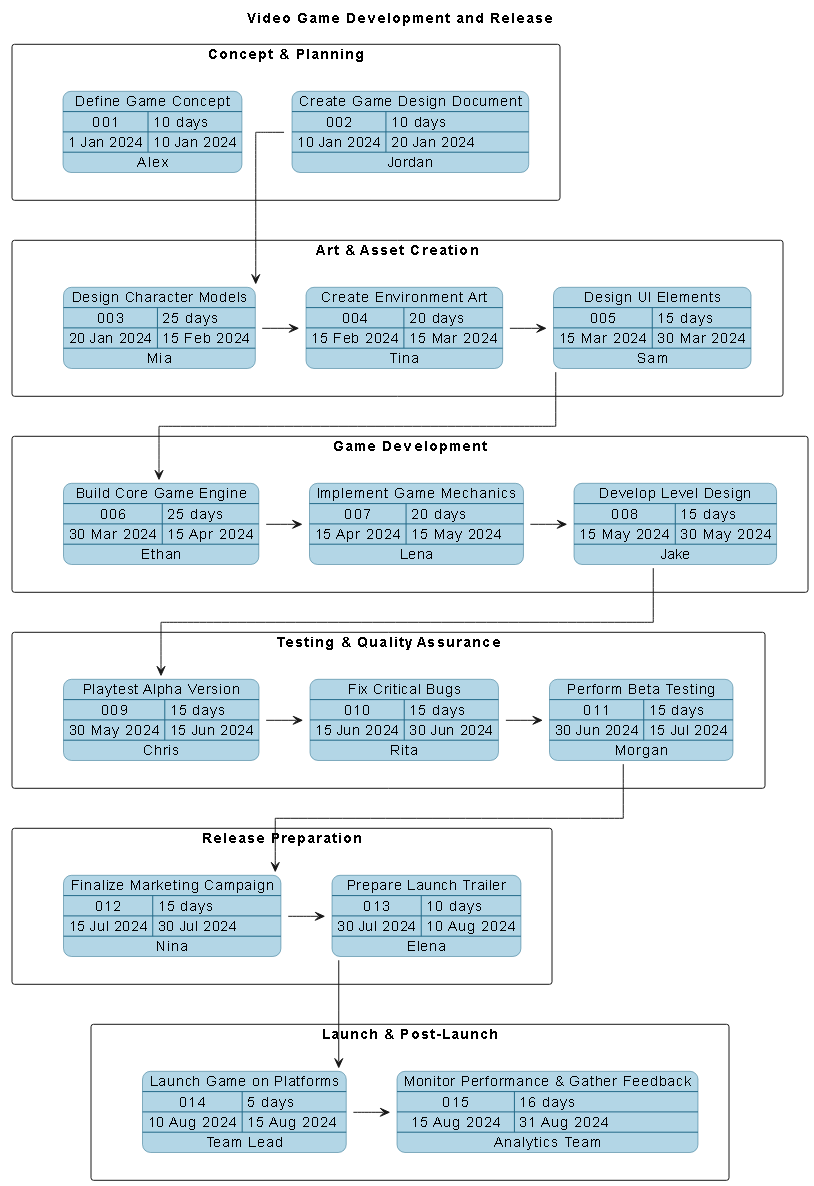
The resulting PERT chart maps the full lifecycle of a video game, organized into logical lanes:
- Concept & Planning: Defining the game idea and drafting the design document
- Art & Asset Creation: Character models, environment art, and UI design
- Game Development: Core engine, mechanics, and level design
- Testing & QA: Alpha, bug fixes, and beta testing
- Release Preparation: Marketing and launch trailer
- Launch & Post-Launch: Platform release and performance monitoring
Each task includes a start date, finish date, duration, and responsible owner—ensuring accountability and visibility. The dependencies are explicitly defined: $dependency(task02, task03), $dependency(task06, task07), and so on—creating a realistic, forward-looking timeline.
Decoding the Logic: Why This PERT Chart Works
The choice of PERT (Program Evaluation and Review Technique) over Gantt or Kanban was deliberate. PERT excels in handling uncertainty—ideal for creative projects where timelines are fluid and dependencies are complex.
Key design decisions in this chart include:
- Sequential dependency chains: Tasks like art creation and development are strictly ordered to reflect real-world constraints (e.g., you can’t design UI without knowing the gameplay mechanics).
- Start-to-finish alignment: The chart uses exact dates (e.g., 1 Jan 2024 to 10 Jan 2024), enabling precise milestone tracking.
- Resource visibility: Each task assigns a responsible owner, helping teams track accountability.
- Visual clarity through lanes: Grouping by phase improves readability and supports stakeholder communication.
Moreover, the AI’s use of PlantUML with $tasksInLane and $dependency functions ensures the diagram is not just visual but executable and reusable. Teams can import it into their workflow tools or regenerate it with updated timelines.
Conversational Intelligence: The AI as a Modeling Partner
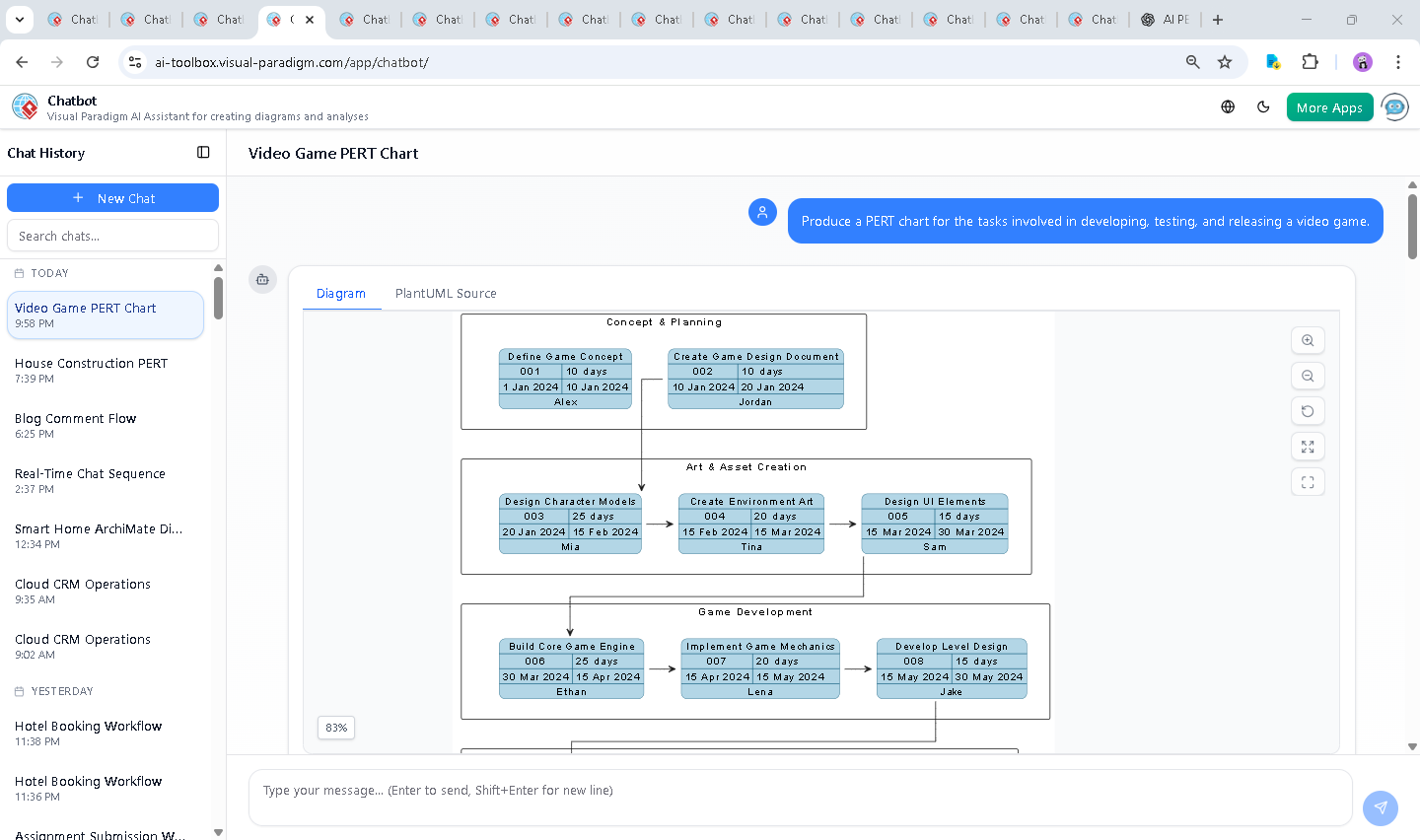
The true power of the Visual Paradigm AI Chatbot lies in its ability to evolve with the user’s intent. After generating the initial PERT chart, the conversation shifted from “Show me the timeline” to “How do we make it faster?”. The AI responded with a full strategic overhaul—restructuring the critical path, recommending scope cuts, and introducing agile practices.
This isn’t a chatbot that answers questions—it’s a collaborative modeling expert. It doesn’t just output diagrams; it interprets context, anticipates follow-ups, and adjusts the model in real time. For example:
- When asked to “Refine the logic”, it clarified dependency chains and suggested parallel work.
- When asked to “Explain this branch”, it broke down the impact of delaying art on development.
- It even proposed a Three-Stage Launch strategy—validating that the AI understands post-launch strategy, not just task scheduling.
These interactions prove that the AI isn’t just a diagram generator. It’s a thinking partner in project planning, capable of handling complex trade-offs and delivering actionable insights.
Beyond PERT: A Full Visual Modeling Suite
While this example focused on PERT, the Visual Paradigm AI Chatbot is built to support a full spectrum of modeling standards. It’s not limited to PERT charts—it can generate and refine:
- UML: Use cases, class diagrams, sequence diagrams for software design
- ArchiMate: Enterprise architecture models, business-IT alignment
- SysML: System-level requirements, behavior, and structure modeling
- C4 Model: Software architecture diagrams (context, containers, components, code)
- Mind Maps, Org Charts, SWOT, PEST, and data visualizations
Whether you’re modeling a startup’s product roadmap, a financial system, or a cloud architecture, the AI Chatbot adapts to your domain—providing consistent, accurate, and collaborative design support across standards.
Conclusion: Launch Faster, Smarter, Together
Creating a video game is more than coding—it’s orchestration. The Visual Paradigm AI Chatbot transforms this process into a dynamic, conversational workflow, where every decision is visualized, validated, and optimized.
From the initial request to the final refinement, the AI didn’t just deliver a diagram. It provided a strategic roadmap, risk-aware guidance, and a living model that evolves with your project.
Ready to build your next project with intelligence and precision? Explore the full PERT chart session and experience how the AI Chatbot turns ideas into structured, executable models.