


Designing Secure, Ethical Facial Recognition: A Conversational Approach to Requirement Modeling
Deploying a facial recognition system in airport security demands more than technical precision—it requires a meticulous balance between high accuracy, real-time performance, and strict privacy compliance. The complexity of aligning these requirements across legal, operational, and ethical domains makes traditional modeling methods slow and error-prone. That’s where the Visual Paradigm AI Chatbot steps in: not as a passive diagram generator, but as a collaborative modeling expert that turns natural language into structured, standards-compliant SysML requirement diagrams.
From Prompt to Precision: The Interactive Journey
The journey began with a simple request: “Produce a SysML requirement diagram describing the requirements of a facial recognition system used in airport security.” Within seconds, the AI Chatbot responded with a fully rendered PlantUML-based SysML Requirement Diagram, complete with traceability, refinement, and containment relationships. But the real value emerged in the conversation that followed.
When the user asked, “Can you explain how the system ensures privacy when facial images are processed in real-time during passenger screening?”, the AI didn’t just restate the requirement—it deepened the design by explaining how on-device processing, anonymized face embeddings, and user consent mechanisms work together to protect biometric data. This wasn’t a generic answer; it was a technical explanation grounded in real-world privacy frameworks like GDPR.
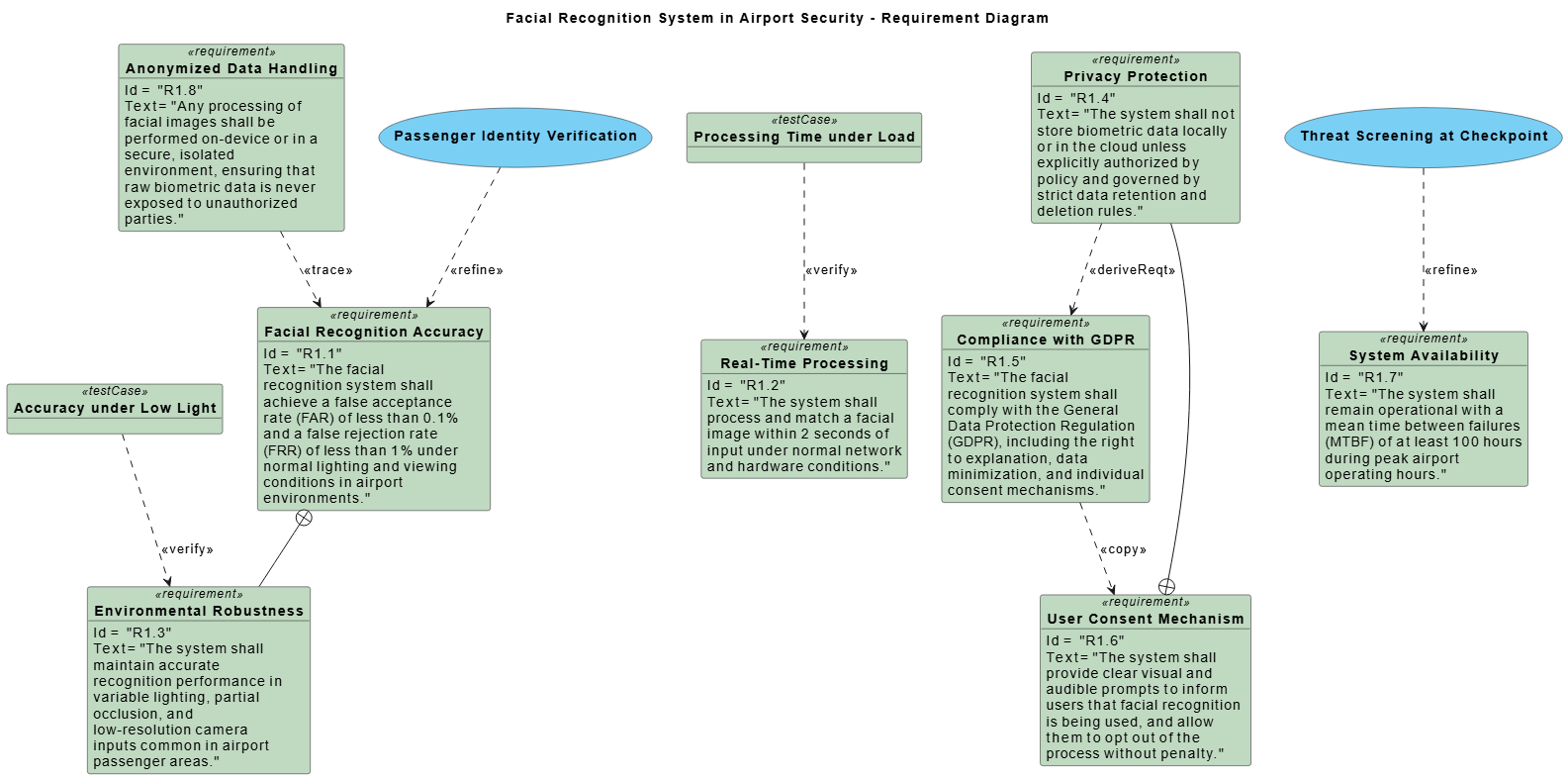
Following this, the user requested refinement: “AI, refine the logic around data retention and anonymization.” The AI responded by updating the diagram with a new requirement: “Anonymized Data Handling”, and linked it to the core accuracy requirement through a $trace relationship, showing how privacy controls directly support system reliability. This level of interactivity isn’t just about diagram updates—it’s about co-designing a secure, compliant system in real time.
The Final Requirement Diagram
Decoding the Logic: Why This Diagram Works
The diagram is built using SysML Requirement Diagram notation, which is ideal for expressing functional, non-functional, and compliance-driven requirements in a structured, verifiable way. Here’s how each element contributes:
- Requirement IDs (e.g., R1.1, R1.2): Each requirement is uniquely labeled and traceable, enabling full auditability and compliance tracking.
- Traceability Relationships: The
$tracebetweenreq08 (Anonymized Data Handling)andreq01 (Facial Recognition Accuracy)shows that privacy measures directly support accuracy—because anonymized processing prevents data leakage that could degrade model performance. - Refinement & Verification:
$refine(useCase01, req01)links the use case “Passenger Identity Verification” to the accuracy requirement, ensuring the system’s purpose is clearly tied to measurable outcomes. Similarly,$verify(testCase01, req03)ties a test case to environmental robustness, confirming that validation is built into the design. - Containment & Derivation:
$containment(req06, req04)shows that the user consent mechanism is nested under privacy protection, emphasizing that consent is not an afterthought but a foundational layer.$deriveReqt(req04, req05)illustrates how GDPR compliance is derived from privacy policy, creating a logical hierarchy of regulatory obligations.
This structure isn’t just visual—it’s design intelligence. The relationships enforce consistency, prevent requirement conflicts, and make the system easier to validate, test, and maintain.
Conversational Intelligence in Action
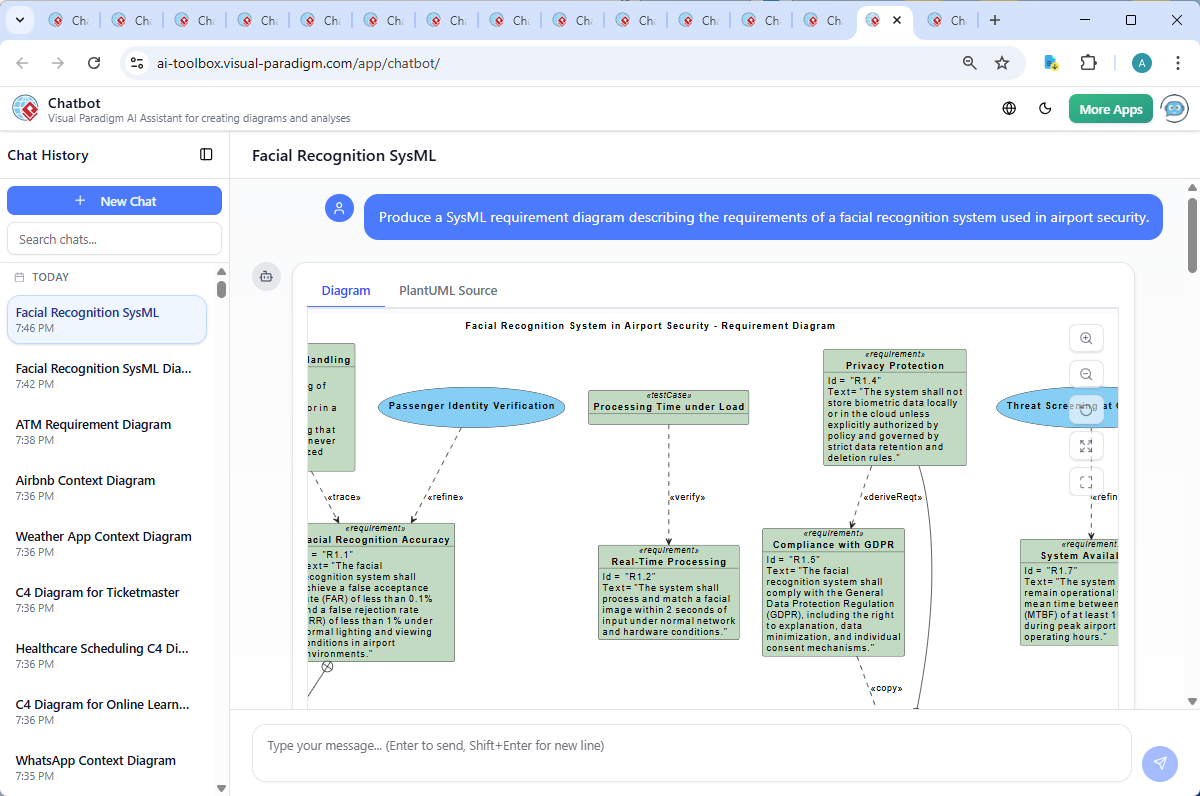
The true strength of the Visual Paradigm AI Chatbot lies in its ability to think like a systems architect. After the initial diagram was generated, the chat history shows how the user and AI co-evolved the model through iterative feedback:
- Clarification Request: “Explain this branch” → AI detailed the privacy-to-accuracy linkage.
- Refinement Request: “AI, refine the logic” → AI updated the diagram to reflect traceability between anonymization and accuracy.
- Expansion Request: “Can you add GDPR compliance?” → AI added
req05and linked it to consent and data minimization.
Each response wasn’t just a diagram update—it was a design decision, informed by real-world constraints and best practices. This level of contextual awareness turns the AI into a true modeling partner, not just a tool.
More Than Just SysML: A Unified Modeling Platform
While this example focused on SysML, the Visual Paradigm AI Chatbot is built to support a full spectrum of modeling standards. Whether you’re designing enterprise architecture with ArchiMate, modeling complex systems with SysML, visualizing software architecture using the C4 Model, or mapping strategic initiatives with SWOT, PEST, or Org Charts, the AI Chatbot adapts to your domain.
For instance, the same conversation could have been extended into:
- A ArchiMate diagram showing the business, application, and technology layers of the airport security system.
- A C4 Model to visualize the system context and container architecture.
- A PERT Chart to map the timeline of deployment and validation phases.
This versatility makes Visual Paradigm not just a diagramming tool, but an AI-powered visual modeling platform that grows with your project’s complexity.
Conclusion: Where Vision Meets Validation
Creating a facial recognition system for airport security isn’t just about technology—it’s about trust, compliance, and human-centered design. The Visual Paradigm AI Chatbot transforms this challenge into a collaborative design process, where every requirement is grounded in logic, every relationship is traceable, and every insight is actionable.
Whether you’re validating accuracy, ensuring privacy, or aligning with GDPR, the AI Chatbot doesn’t just generate diagrams—it guides you through the design decisions that matter.
Ready to build your next system with confidence? Explore the full session and see how the AI Chatbot turns your vision into a validated, model-driven reality.