


Designing a Scalable Ride-Sharing Ecosystem with AI-Driven Requirement Modeling
Building a mobile ride-sharing application like Uber demands more than just a sleek interface—it requires a rigorous, traceable foundation of system requirements. The challenge lies in capturing complex, interdependent behaviors: real-time ride matching under pressure, secure authentication, surge pricing logic, and emergency response protocols—all while ensuring compliance, fairness, and scalability. This is where the Visual Paradigm AI Chatbot transforms the design process from manual drafting to intelligent collaboration.
From Prompt to Precision: An Interactive Journey with the AI Chatbot
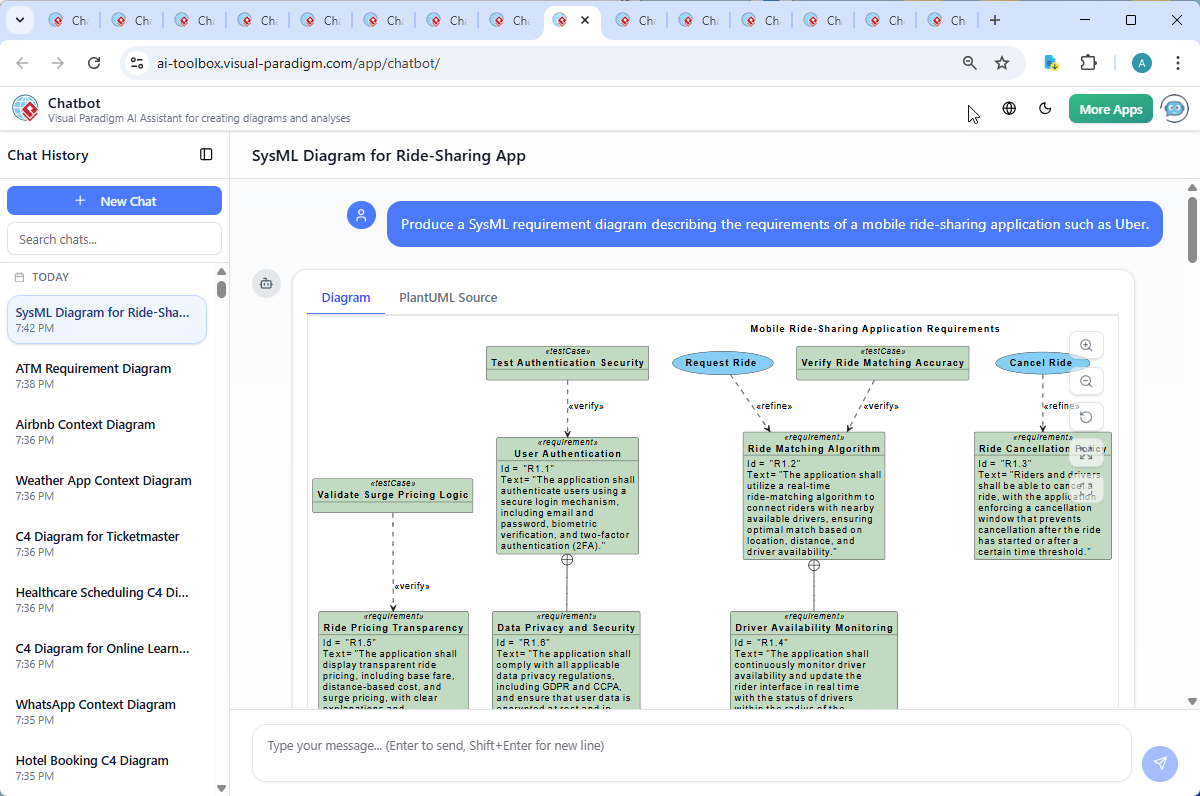
The journey began with a simple request: “Produce a SysML requirement diagram describing the requirements of a mobile ride-sharing application such as Uber.” Within seconds, the AI Chatbot delivered a fully rendered SysML Requirement Diagram using PlantUML syntax, complete with structured requirements, use cases, test cases, and traceability links. But the real value emerged not in the initial output—but in the conversation that followed.
When the user asked, “Can you explain how the ride-matching algorithm handles edge cases like high demand during peak hours?”, the AI didn’t just offer a general answer. It provided a detailed, layered breakdown of the algorithm’s resilience mechanisms—covering surge pricing, predictive driver allocation, geographic hotspots, and fairness safeguards. This wasn’t a static document; it was a living design conversation.
Each follow-up request—like refining logic, asking for explanations, or probing deeper into security—triggered a new level of insight. The AI didn’t just respond; it refined the model. For instance, when the user requested clarification on how driver availability is monitored, the AI updated the diagram’s containment relationships and added contextual notes on real-time status tracking. This iterative dialogue mirrors how architects and engineers collaborate in real-world projects—only faster, smarter, and powered by AI.
Visualizing the Core Requirements
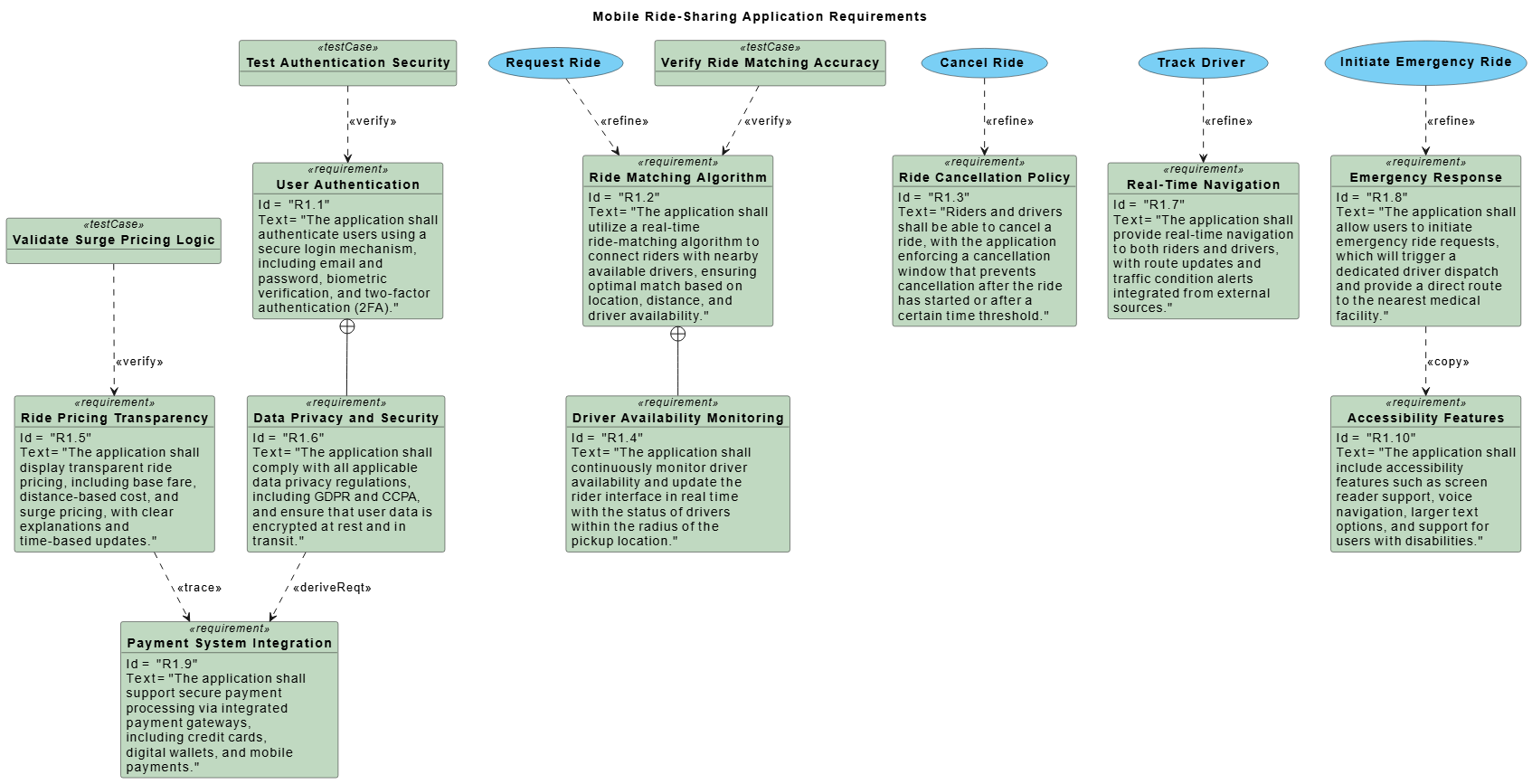
The final SysML Requirement Diagram captures 10 core system requirements, each anchored to a unique ID and traceable to use cases and test cases. Key elements include:
- Requirement 1.1 (User Authentication): Enforces multi-factor security with biometrics and 2FA.
- Requirement 1.2 (Ride Matching Algorithm): The backbone of the system, optimized for real-time proximity and availability.
- Requirement 1.5 (Ride Pricing Transparency): Ensures riders understand surge dynamics and cost breakdowns.
- Requirement 1.8 (Emergency Response): Enables rapid dispatch to medical facilities with dedicated routing.
Each requirement is linked via $refine to a use case, $verify to a test case, and $containment to ensure hierarchical integrity. For example, $containment(req01, req06) shows that secure authentication is a prerequisite for data privacy compliance.
Decoding the Logic: Why SysML and Traceability Matter
Choosing SysML for this diagram wasn’t arbitrary. It’s the industry-standard language for systems engineering, especially in complex, safety-critical domains. Unlike generic UML, SysML supports:
- Requirements modeling with clear traceability
- Block definition diagrams for system decomposition
- Internal block diagrams for behavioral logic
- Parametric modeling for performance constraints (e.g., max wait time)
In this case, the AI used SysML’s $requirement and $useCase constructs to create a formal, machine-readable specification. The $deriveReqt and $trace relationships show how high-level goals (e.g., secure payments) are derived from and linked to implementation-level features (e.g., payment gateway integration).
For example, $trace(req05, req09) explicitly links pricing transparency to payment processing—ensuring that cost visibility isn’t an afterthought, but a foundational requirement.
Conversational Intelligence in Action
What sets Visual Paradigm’s AI Chatbot apart is its ability to act as a modeling consultant—not just a generator. The chat history shows a dynamic, responsive exchange:
- “Can you explain how the ride-matching algorithm handles edge cases?” → AI responded with a structured, multi-layered analysis of surge pricing, predictive routing, and fairness mechanisms.
- “Explain this branch” → AI clarified the containment hierarchy between authentication and data privacy.
- “Refine the logic” → AI adjusted traceability links and added context to ensure compliance with GDPR and CCPA.
These aren’t canned responses. They’re intelligent, context-aware interventions that elevate the design process from documentation to co-creation.
Beyond SysML: A Unified Modeling Platform
While this example focused on SysML, the Visual Paradigm AI Chatbot is not limited to one standard. It supports a full suite of modeling languages, including:
- UML for software design and component modeling
- ArchiMate for enterprise architecture and business capability mapping
- C4 Model for software architecture visualization (Context, Containers, Components, Code)
- Mind Maps for brainstorming and idea structuring
- PERT Charts, Org Charts, SWOT, PEST for strategic planning and project management
Whether you’re designing a new feature, mapping business processes, or modeling system behavior, the AI Chatbot adapts to your needs—providing consistent, accurate, and collaborative modeling support across the entire lifecycle.
Conclusion: The Future of Visual Modeling is Conversational
Creating a robust, scalable ride-sharing platform demands precision, foresight, and collaboration. With Visual Paradigm’s AI Chatbot, that process becomes intuitive, iterative, and deeply intelligent. From the initial prompt to the final traceable requirement, the AI doesn’t just generate diagrams—it guides, explains, and evolves the model in real time.
Ready to build smarter systems? Try crafting your next requirement diagram with the Visual Paradigm AI Chatbot and experience the future of visual modeling.