


Designing a Secure ATM Cash Withdrawal Flow with AI-Powered Precision
Modeling complex system interactions—like a customer withdrawing cash from an ATM—requires clarity, accuracy, and foresight. The traditional approach to sequence diagrams often involves iterative design, manual notation, and deep domain knowledge. With Visual Paradigm’s AI Chatbot, this process transforms into a dynamic, conversational collaboration that evolves with your intent.
From Prompt to Polished: A Collaborative Design Journey
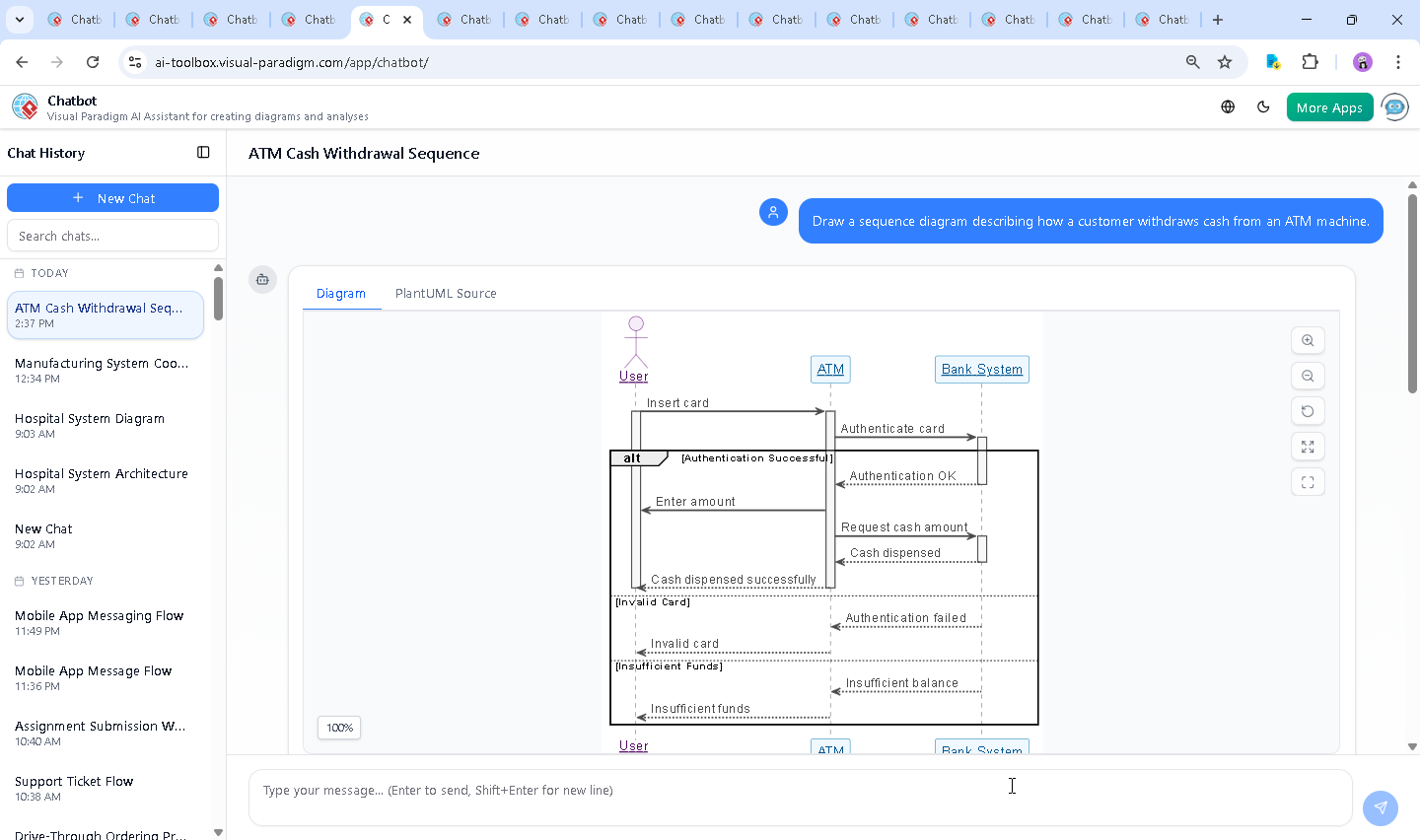
It began with a simple request: “Draw a sequence diagram describing how a customer withdraws cash from an ATM machine.” The AI Chatbot responded instantly with a fully rendered UML sequence diagram, complete with proper lifelines, activation bars, and conditional logic using alt blocks for error scenarios like invalid cards or insufficient funds.
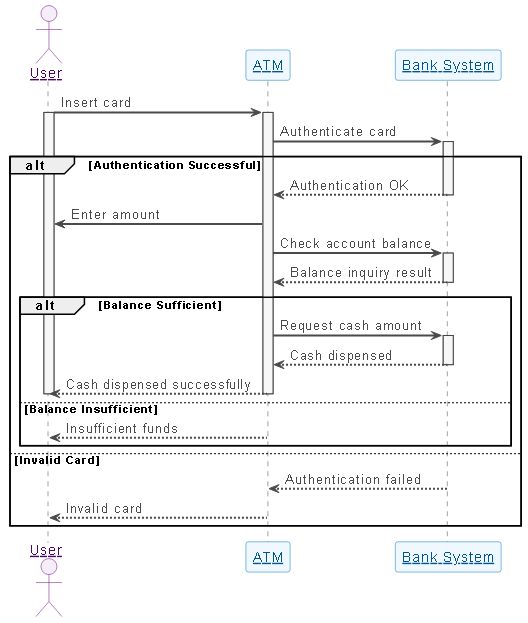
But the real value emerged in the next round. The user asked: “How would the sequence diagram change if the ATM sends a balance inquiry before dispensing cash?” This wasn’t just a tweak—it was a strategic shift in system behavior. The AI interpreted the request not as a simple edit, but as a design enhancement. It inserted a new interaction: ATM -> BS: Check account balance, followed by a nested alt block to handle balance sufficiency.
Each iteration reflected the AI’s understanding of system logic, transaction safety, and user experience. The chatbot didn’t just generate code—it acted as a modeling consultant, suggesting best practices like separating balance checks from cash dispensing to prevent overdrafts.
Decoding the Logic: Why This Flow Works
The final sequence diagram captures a realistic, secure ATM transaction with the following key phases:
- Card Insertion: The user inserts their card. The ATM initiates authentication.
- Authentication: The ATM sends the card details to the Bank System. If invalid, the process ends with an error.
- Balance Inquiry (Added Logic): After successful authentication, the ATM checks the account balance before proceeding to cash withdrawal—this prevents accidental overdrafts.
- Conditional Cash Request: Only if the balance is sufficient does the ATM request cash from the bank.
- Dispensing & Feedback: Upon approval, the bank sends the cash amount, the ATM dispenses cash, and the user receives confirmation.
The use of alt blocks for success and failure conditions ensures the diagram models real-world scenarios without clutter. The activate and deactivate directives clearly visualize the duration of each system’s involvement, reinforcing the temporal nature of interactions.
Conversational Intelligence in Action
What sets this process apart is not just the output, but the dialogue. The AI Chatbot doesn’t generate static diagrams—it evolves them through conversation. When the user requested a change, the AI didn’t just re-render the diagram; it re-evaluated the flow, ensured logical consistency, and maintained diagram integrity.
For example, after the balance inquiry was added, the AI correctly nested the cash request under a new alt block for sufficient funds, avoiding any overlap or ambiguity. This level of contextual awareness demonstrates the AI’s deep understanding of sequence diagram semantics and system design principles.
Beyond Sequence Diagrams: A Unified Modeling Platform
While this example focuses on sequence diagrams, the Visual Paradigm AI Chatbot is not limited to one standard. It seamlessly supports UML, ArchiMate, SysML, C4 Model, and Mind Maps. Whether you’re modeling enterprise architecture with ArchiMate, designing complex systems with SysML, or visualizing software components via C4, the AI Chatbot adapts to your needs.
Need a C4 model of the same ATM system? The AI can generate a context diagram, container view, and component view—all in conversation. Want to model the process behind ATM transactions using activity diagram? The AI will guide you through the steps with the same precision.
Conclusion: Design with Confidence, Powered by AI
Creating accurate, professional sequence diagrams no longer requires hours of manual drafting or deep UML expertise. With Visual Paradigm’s AI Chatbot, you collaborate with an intelligent modeling partner that understands system logic, adapts to feedback, and delivers production-ready diagrams in real time.
Whether you’re an architect, developer, or business analyst, the ability to refine your design through natural conversation accelerates delivery and improves quality.
Start your next modeling session today—turn your ideas into precise, AI-crafted diagrams with Visual Paradigm.