


Designing a Secure Flight Booking Workflow with AI-Powered Precision
Creating a clear, accurate sequence diagram for a complex system like an online flight booking process demands more than diagramming skills—it requires deep understanding of user flows, system interactions, and security protocols. The challenge lies in modeling not just the steps, but the logic behind them: how data flows, how errors are handled, and how security is embedded at every stage.
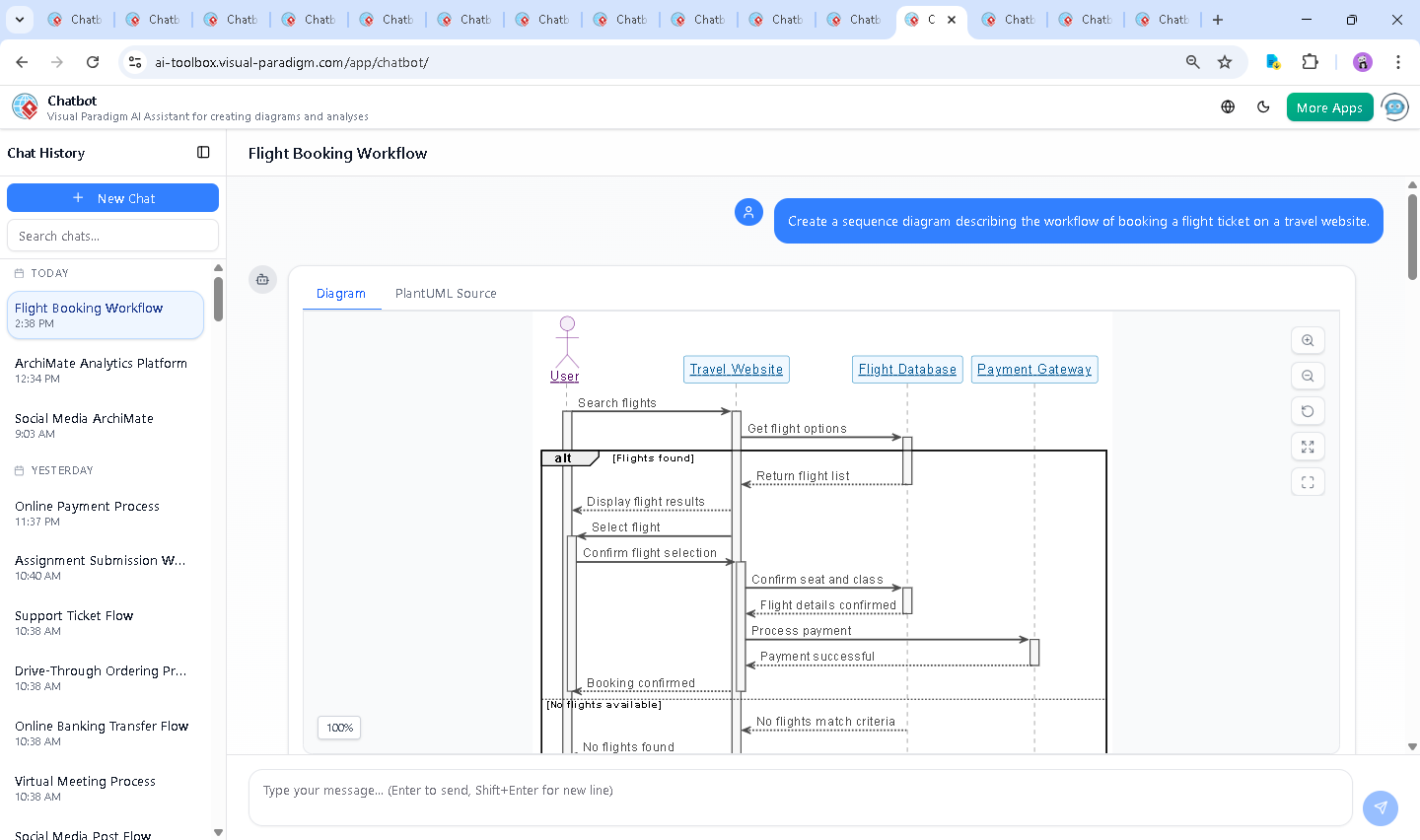
Enter the Visual Paradigm AI Chatbot—a collaborative modeling expert that transforms natural language into structured, standards-compliant diagrams. Instead of starting from scratch, the user simply described their intent: “Create a sequence diagram describing the workflow of booking a flight ticket on a travel website.” Within seconds, the AI generated a complete UML sequence diagram with proper lifelines, activation bars, conditional branches, and clear participant roles.
From Prompt to Diagram: An Interactive Modeling Journey
The real power of Visual Paradigm lies not in generating diagrams, but in co-creating them through conversation. The user’s initial request sparked a dynamic exchange, where each follow-up refined the model’s depth and accuracy.
After the initial diagram was generated, the user asked: “How does the travel website ensure payment security when processing transactions?” Rather than treating this as a separate query, the AI treated it as a critical design enhancement. It responded with a detailed breakdown of security mechanisms—SSL/TLS encryption, PCI DSS compliance, tokenization, fraud detection—each directly tied to the diagram’s logic.
When the user requested clarification on a specific branch, such as “Explain this branch” or “Refine the logic for payment failure,” the AI didn’t just restate the diagram—it explained the design rationale: why the <alt> block was used, how error states were isolated, and why the payment gateway was modeled as a separate participant to emphasize data segregation.
This back-and-forth isn’t just helpful—it’s transformative. The AI functions as a modeling consultant, ensuring every element serves both functional and architectural purpose.
Decoding the Sequence Diagram Logic
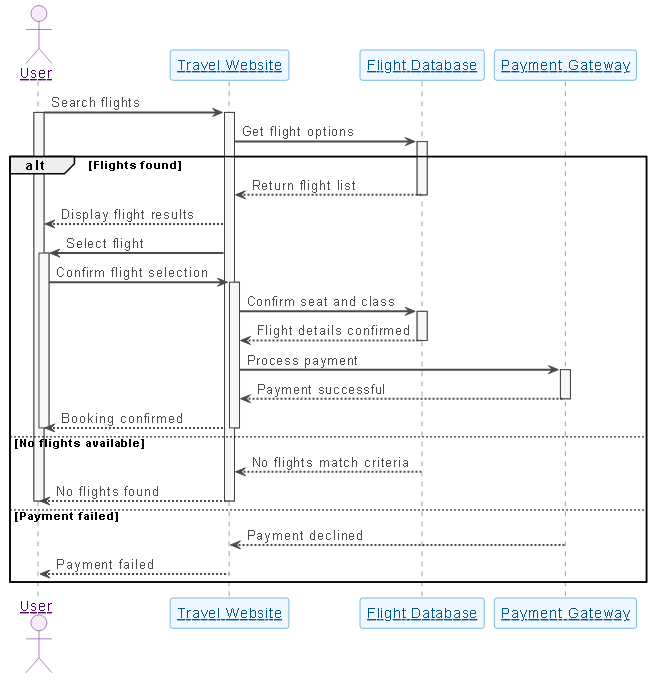
The generated sequence diagram captures the full flight booking lifecycle with precision and clarity. Let’s break down the core logic:
1. User Initiation
The user starts by searching for flights. This triggers the first interaction: USR → TW: Search flights. The activation bar on the user and the travel website shows this is an active, time-bound action.
2. Flight Retrieval via Database
The travel website queries the Flight Database. The Get flight options message is sent, and the database responds with either flight data or a no-results message.
3. Conditional Branching: Key to Real-World Accuracy
The alt block is critical here. It models three distinct paths:
- Flights found: The system returns a list, the user selects a flight, and the process continues with seat confirmation and payment.
- No flights available: The system gracefully informs the user, avoiding unnecessary processing.
- Payment failed: A separate error path ensures the system handles declined transactions without crashing.
Using alt instead of opt was intentional—this reflects real-world scenarios where multiple outcomes are possible, and each must be modeled explicitly for clarity and maintainability.
4. Payment Security Integration
The Payment Gateway participant is not just a placeholder—it’s a deliberate design choice. The AI ensured that payment processing is isolated from the core application, reinforcing security best practices. The Process payment message is sent only after flight confirmation, and the response—whether success or failure—is handled in a way that prevents data leakage.
5. Final Confirmation
Upon successful payment, the system sends a confirmation back to the user. The deactivation of all lifelines signals the end of the interaction, ensuring no dangling processes.
Conversational Intelligence in Action
What sets Visual Paradigm apart is the depth of insight the AI brings to the conversation. When the user asked about payment security, the AI didn’t just list features—it explained how each one integrates into the diagram’s structure.
For example, the mention of tokenization wasn’t just a footnote—it was linked to the diagram’s design: since card data is never stored, the system avoids long-lived interactions with sensitive data, which is reflected in the diagram’s clean, minimal flow.
Similarly, the PCI DSS compliance note wasn’t just a compliance check—it informed the design principle: never handle card data directly. This is why the payment gateway is a distinct participant, and why the user never sees the card details.
Beyond Sequence Diagrams: A Unified Modeling Platform
While this example focused on a sequence diagram, the Visual Paradigm AI Chatbot is built to support a full spectrum of modeling standards. Whether you’re designing enterprise architectures with ArchiMate, modeling complex systems with SysML, visualizing software architecture using the C4 Model, the AI adapts to your needs.
Need a component diagram to show how the payment gateway integrates with the backend? The AI can generate it. Want to map out the business actors in a travel booking ecosystem using ArchiMate? It’s just a prompt away. The same conversational intelligence applies across all domains.
Conclusion: AI That Thinks Like a Modeler
Visual Paradigm isn’t just a diagramming tool. It’s an AI-powered visual modeling platform where the chatbot acts as a true design partner—understanding intent, refining logic, and ensuring models are not just visually accurate, but architecturally sound.
Whether you’re a developer, architect, or business analyst, the ability to describe a system in plain language and receive a precise, standards-compliant diagram is a game-changer. The conversation isn’t a loop—it’s a collaborative design session, where every question deepens the model.
Ready to build your next system with confidence? Try it today and see how the Visual Paradigm AI Chatbot turns ideas into models—fast, smart, and secure.