


From Idea to Precision: How the AI Chatbot Built a Secure Notification Delivery Sequence Diagram
Designing a reliable notification delivery system requires clarity on how messages move from trigger to device—especially when security, timing, and user experience are at stake. The challenge lies not just in mapping the flow, but in ensuring every step is logically sound, validated, and scalable. Enter the Visual Paradigm AI Chatbot: not a passive diagram generator, but a collaborative modeling expert that transforms vague ideas into precise, standards-compliant models through natural conversation.
Interactive Journey: From Prompt to Insight
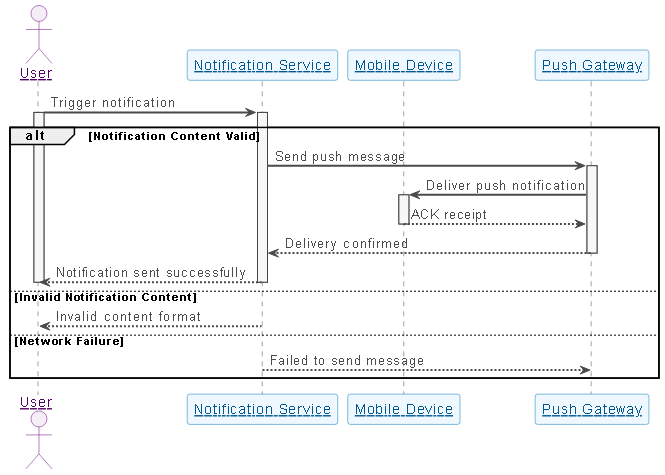
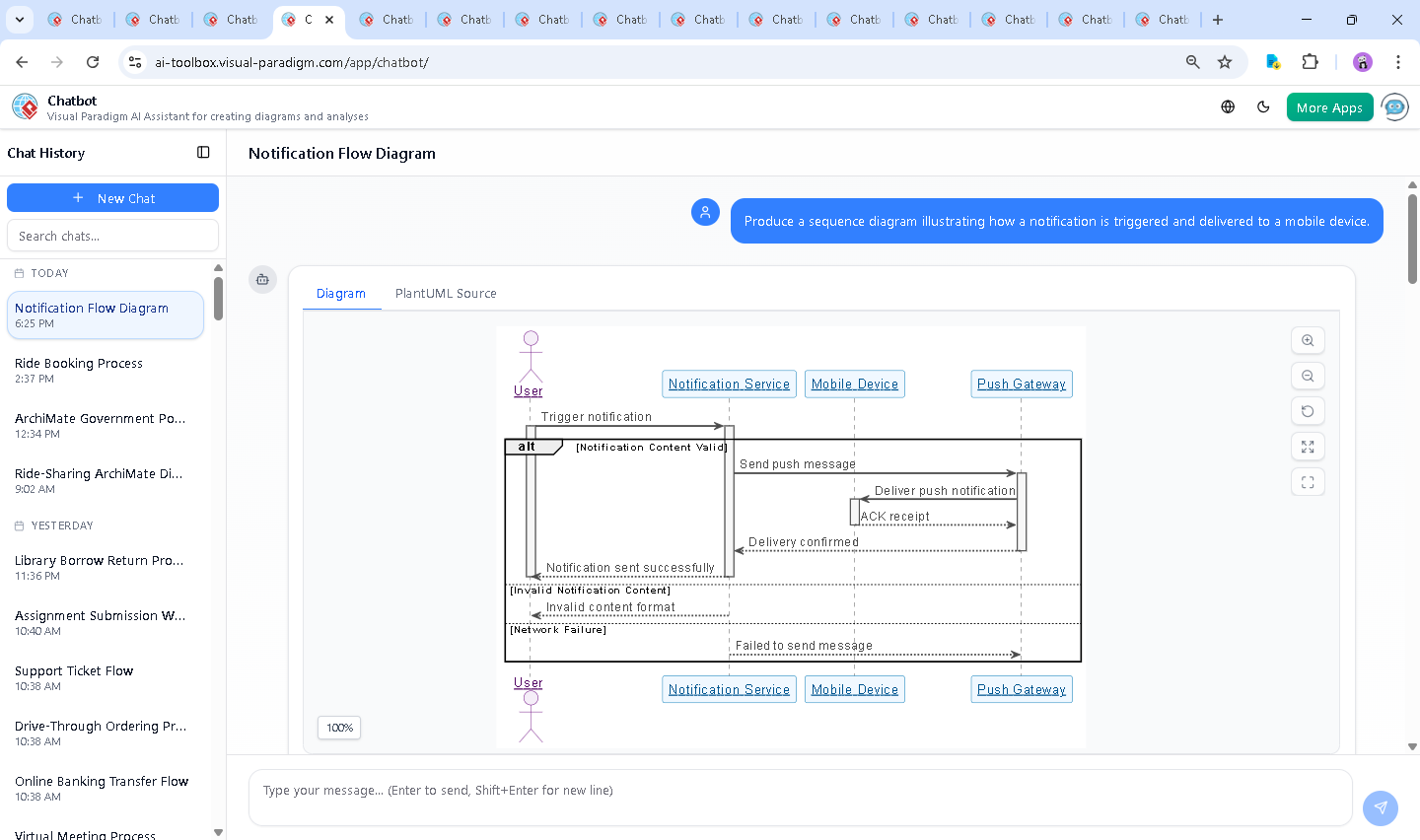
The process began with a simple request: “Produce a sequence diagram illustrating how a notification is triggered and delivered to a mobile device.” Within seconds, the AI Chatbot delivered a fully rendered PlantUML-based sequence diagram—complete with actors, participants, activation bars, and conditional logic. But this wasn’t the end. The real value emerged in the conversation that followed.
When the user asked, “Can you explain how the notification service validates the content before sending it to the push gateway?”, the AI didn’t just answer—it deepened the design. It outlined a multi-layered validation process: schema checks, length limits, sanitization, policy enforcement, authentication, and expiry validation. This wasn’t a static explanation; it was a live modeling consultation, refining the diagram’s semantics in real time.
Even more compelling was the AI’s ability to integrate this new insight directly into the diagram’s logic. It suggested adding internal validation steps—such as Validate content schema and Sanitize body to prevent injection—to reflect the actual workflow inside the Notification Service. This level of contextual intelligence turns the AI Chatbot into a trusted design partner, not just a tool.
Logic Breakdown: Why This Sequence Diagram Works
The diagram captures the full lifecycle of a notification with precision and clarity. Here’s how each component contributes to the overall logic:
1. Trigger and Activation
The user initiates the process by triggering a notification. The USR actor sends the request to the Notification Service (NS), which activates its lifecycle.
2. Conditional Branching for Real-World Scenarios
The alt block introduces real-world resilience:
- Valid Content: If the message passes validation, the NS forwards it to the
Push Gateway (PG). - Invalid Content: If the schema or format fails, the NS responds with an error, preventing malformed messages from propagating.
- Network Failure: If the PG is unreachable, the NS logs the failure—critical for monitoring and retry mechanisms.
3. Delivery Confirmation Loop
After the PG delivers the notification to the Mobile Device (MD), the device sends an acknowledgment (ACK). This feedback loop ensures the system knows the message was received, enabling retry logic or logging if needed.
4. Why Sequence Diagrams? The Notation Choice
Sequence diagrams are ideal here because they emphasize time and order. The vertical lifelines and horizontal messages clearly show:
- Who initiates each action
- When each component becomes active
- How responses are returned
This makes the diagram perfect for debugging, onboarding, or documenting system behavior—especially in distributed environments where timing and state matter.
Conversational Value: The AI as a Modeling Consultant
What sets Visual Paradigm apart is how deeply the AI Chatbot engages in the design process. It doesn’t just output code—it interprets intent, anticipates follow-ups, and enriches the model with domain knowledge.
For instance, after the user requested clarification on content validation, the AI didn’t just define the steps—it showed how to visualize them within the diagram’s structure. This kind of responsive insight turns a basic diagram into a living specification.
Even more impressive: the AI’s ability to handle complex follow-ups like “Explain this branch” or “Refine the logic for security” demonstrates a true understanding of modeling best practices. The conversation wasn’t a series of isolated replies—it was a collaborative design session.
Platform Versatility: Beyond Sequence Diagrams
While this example focused on a Sequence Diagram, the Visual Paradigm AI Chatbot is built to support a full suite of modeling standards. Whether you’re designing enterprise architecture with ArchiMate, modeling complex systems with SysML, visualizing software architecture using the C4 Model, or brainstorming ideas with Mind Maps, the AI adapts to your needs.
This versatility means you’re not locked into one diagram type. The same AI assistant that helped define component relationships in UML, or map stakeholder interactions in ArchiMate—all through natural conversation.
Conclusion & CTA
Creating a secure, scalable notification flow isn’t just about drawing lines and boxes. It’s about capturing intent, validating logic, and ensuring every step aligns with real-world behavior. With Visual Paradigm’s AI Chatbot, you’re not just generating diagrams—you’re co-designing with an expert.
Try the AI-powered visual modeling platform today and experience how natural conversation turns ideas into precise, production-ready models.