


Designing a Seamless Hotel Booking Experience with AI-Powered Sequence Modeling
Booking a hotel room online involves a complex interplay of user actions, system responses, and third-party integrations—especially when it comes to secure payment processing. The challenge lies in clearly visualizing these interactions without getting lost in technical noise. This is where the Visual Paradigm AI Chatbot steps in as a collaborative modeling partner, transforming abstract ideas into precise, actionable sequence diagrams through natural conversation.
From Concept to Clarity: An Interactive Modeling Journey
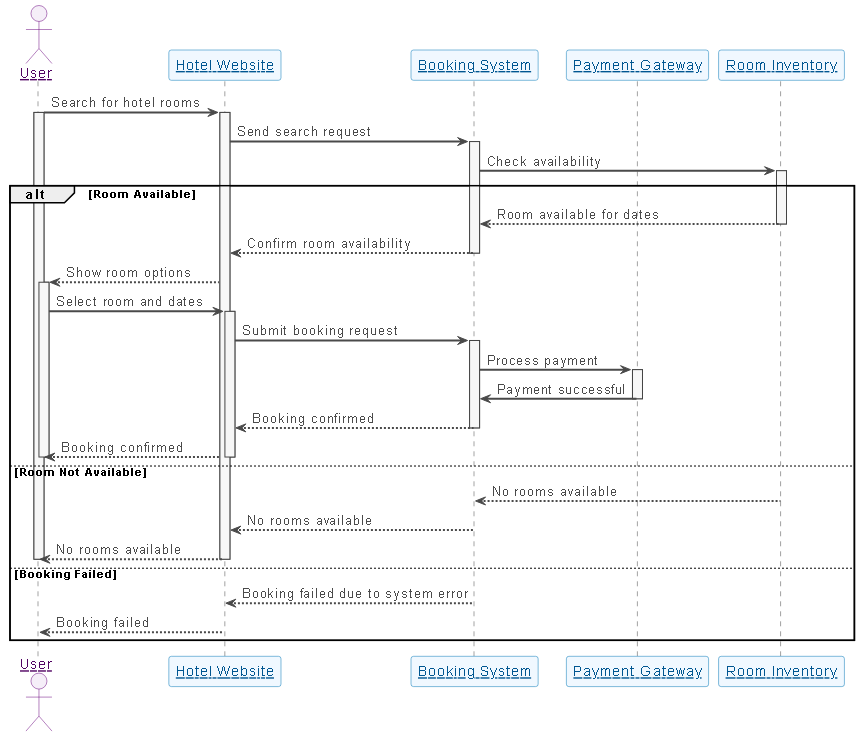
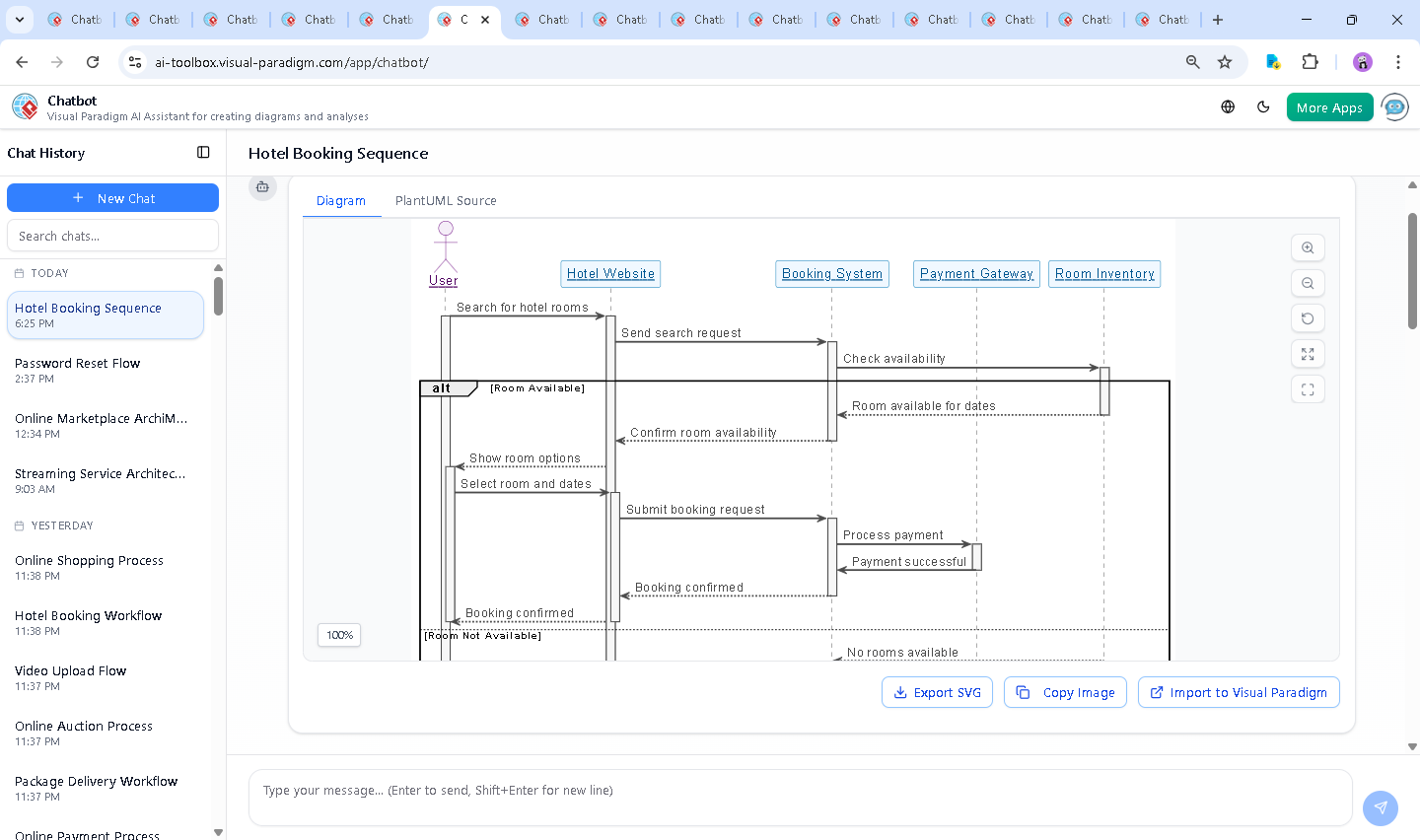
The journey began with a simple request: “Generate a sequence diagram to show the steps involved in booking a hotel room online.” Within seconds, the Visual Paradigm AI Chatbot delivered a fully rendered SequenceDiagram using PlantUML syntax, complete with participant lifelines, activation bars, and conditional logic. The diagram captured the core flow—user search, system validation, availability check, and payment processing—using industry-standard UML notation.
But the conversation didn’t stop there. The user asked, “Can you explain how the payment gateway handles different payment methods?” This wasn’t just a clarification request—it was a design deep dive. The AI responded with a detailed breakdown of how payment gateways support multiple methods, including credit cards, digital wallets, bank transfers, cryptocurrency, and BNPL services. It highlighted security protocols like PCI DSS, 3D Secure, and tokenization, demonstrating its grasp of both technical and compliance realities.
What made this interaction stand out was the AI’s ability to pivot from diagram generation to expert consultation. It didn’t just answer the question—it enriched the modeling context, enabling the user to make informed design decisions. When the user asked for a follow-up diagram, the AI was ready to adapt, showing that it functions not as a static tool, but as a dynamic modeling advisor.
Decoding the Sequence Diagram Logic
The generated sequence diagram follows a structured, event-driven logic that mirrors real-world booking behavior. Here’s how each component contributes:
- Actor: User initiates the process by searching for rooms, triggering the flow.
- Hotel Website (HW) acts as the interface, receiving input and forwarding requests to the Booking System.
- Booking System (BS) is the central orchestrator. It validates the search, checks inventory, and manages the booking lifecycle.
- Room Inventory (RI) provides real-time availability data. Its response determines whether the flow proceeds to payment or fails.
- Payment Gateway (PG) handles transaction processing. It’s isolated from the core booking logic, emphasizing modularity and security.
The alt block structure is key: it models branching logic based on availability and system status. If rooms are available, the flow proceeds to payment. If not, the user receives immediate feedback. A third branch—”Booking Failed”—covers error scenarios, ensuring the system is resilient and user-friendly.
Notably, the diagram uses activation bars to show when each participant is actively processing a message. This visual cue helps stakeholders understand performance bottlenecks and concurrency risks. The use of deactivate statements ensures clarity on when each component finishes its role, preventing visual clutter.
Conversational Intelligence in Action
What sets Visual Paradigm apart is how the AI Chatbot evolves with the conversation. The user’s follow-up question—”Explain how the payment gateway handles different payment methods”—triggered a shift from diagram generation to technical explanation. The AI didn’t just list payment types; it contextualized them with real-world workflows, compliance standards, and security mechanisms.
For example, it explained that digital wallets like Apple Pay use tokenization to prevent card data exposure, while BNPL services involve credit checks via third-party providers. These insights aren’t just helpful—they’re critical for architects designing secure, scalable systems.
This level of contextual understanding is only possible because the AI Chatbot is trained on a vast library of modeling best practices across UML, ArchiMate, SysML, and C4 Model. It doesn’t just generate diagrams—it guides the design process.
Beyond Sequence Diagrams: A Full Modeling Suite
While this example focused on a Sequence Diagram, the Visual Paradigm AI Chatbot is not limited to one standard. It seamlessly supports a wide range of modeling languages, including:
- UML (for software and system design)
- ArchiMate (for enterprise architecture and business-IT alignment)
- SysML (for systems engineering and complex requirements modeling)
- C4 Model (for software architecture visualization at multiple levels)
Whether you’re modeling a payment flow, designing a cloud-native microservice architecture, or mapping stakeholder interactions in a digital transformation initiative, the AI Chatbot adapts to your needs. It understands the nuances of each standard and applies them consistently, reducing the risk of misinterpretation and rework.
Conclusion: Design Smarter, Not Harder
Creating accurate, meaningful sequence diagrams doesn’t require deep technical expertise—or endless trial and error. With Visual Paradigm’s AI Chatbot, you get a collaborative modeling environment where ideas are transformed into precise, standards-compliant diagrams through natural conversation.
Whether you’re a developer, architect, or business analyst, the ability to refine logic, explore alternatives, and receive expert insights in real time is game-changing. The AI doesn’t just generate diagrams—it guides the design process, ensuring clarity, correctness, and scalability from day one.
Ready to build your next system with confidence? Try the shared session and experience how the Visual Paradigm AI Chatbot turns your vision into a visual reality.