


Visualizing Real-Time Message Flow: How a User Sends a Message in a Chat App
Designing real-time communication systems demands precision in modeling interactions—especially when users expect instant delivery, clear feedback, and resilience under failure. Traditional diagramming tools often slow down this process, but with Visual Paradigm’s AI Chatbot, the entire workflow becomes a collaborative dialogue. Instead of manually drafting each lifeline or condition, the user starts with a simple intent—and the AI responds with a structured, accurate sequence diagram.
From Idea to Diagram: A Collaborative Design Journey
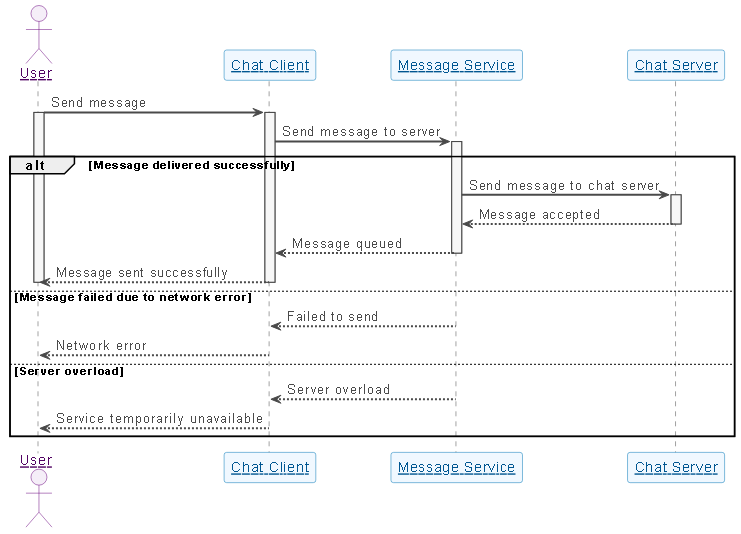
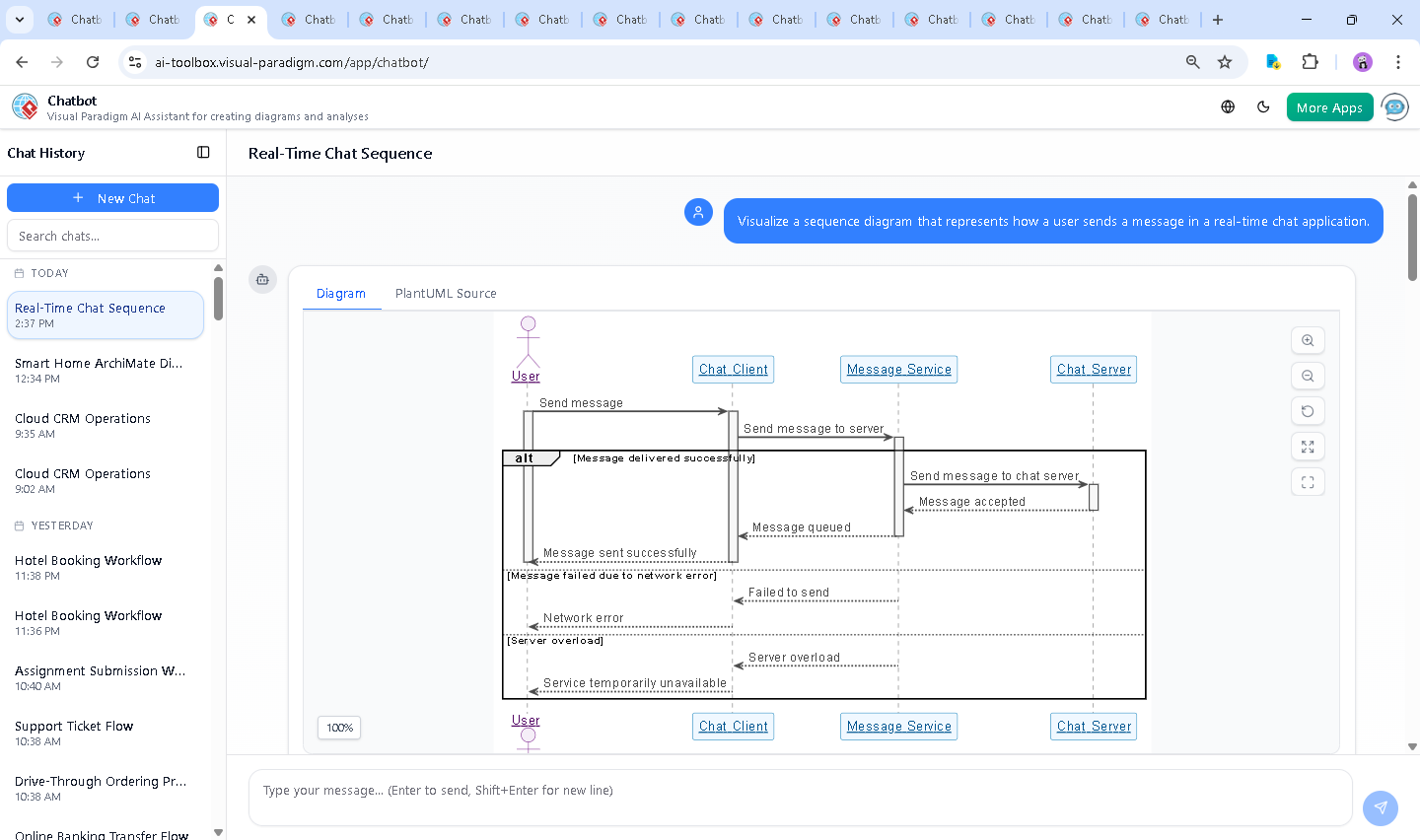
The journey began with a straightforward request: “Visualize a sequence diagram that represents how a user sends a message in a real-time chat application.” Within seconds, the Visual Paradigm AI Chatbot delivered a fully rendered SequenceDiagram using PlantUML syntax, complete with participant roles, activation bars, and conditional logic.
But the conversation didn’t stop there. The user asked, “Explain this diagram,” prompting the AI to break down the flow into clear sections: participants, sequence steps, and error handling. This wasn’t just a static output—it was a dynamic exchange where the AI acted as a modeling consultant, anticipating the need for clarity and depth.
When the user requested further refinement, the AI adapted: it explained the use of alt blocks to represent success and failure paths, clarified why the Message Service sits between the client and server (for validation and routing), and emphasized how each activation bar reflects a component’s active role in processing.
Decoding the Sequence: Logic Behind the Flow
The diagram captures the full lifecycle of a message from user input to system feedback, with intentional design choices that reflect real-world constraints:
- Modular Architecture: The separation between
Chat Client,Message Service, andChat Serverreflects a scalable backend pattern—each component handles a distinct responsibility. - Real-Time Responsiveness: Activation bars show that processing happens synchronously; the user doesn’t wait for long delays, ensuring a fluid experience.
- Failure Resilience: The
altconstruct models three distinct outcomes:- Success: Message accepted, queued, and confirmed.
- Network Error: The client notifies the user immediately, preventing confusion.
- Server Overload: The system gracefully handles high load by returning a temporary error, avoiding crashes.
These conditions aren’t just theoretical—they reflect common pain points in real-time apps. By visualizing them upfront, teams can plan for retries, caching, or fallback mechanisms.
Conversational Intelligence in Action
What sets Visual Paradigm apart is how the AI doesn’t just generate diagrams—it guides. When the user asked for an explanation, the AI didn’t just list components. It contextualized each step, highlighted design principles, and even offered next steps: “Let me know if you’d like a version with more details, additional security checks, or integration with push notifications!”
This kind of responsiveness turns the AI into a co-designer. Whether refining logic, adding security layers (e.g., message encryption), or extending the flow to include notification delivery, the chatbot adapts in real time—no switching between tools, no context loss.
Beyond Sequence Diagrams: A Unified Modeling Platform
While this example focused on a sequence diagram, the Visual Paradigm AI Chatbot is not limited to one standard. It seamlessly supports UML, ArchiMate, SysML, C4 Model, and Mind Maps. Whether you’re modeling enterprise architecture, system behavior, or business processes, the AI understands the semantics of each notation and generates accurate, production-ready diagrams.
For instance, if you needed to map the same message flow in ArchiMate to show how business actors interact with IT services, or in C4 Model to illustrate the context of the chat client within the larger system landscape, the AI would adjust accordingly—maintaining consistency and accuracy across models.
Conclusion: Design Smarter, Faster, Together
Creating a sequence diagram for a real-time chat app used to require multiple iterations, expert knowledge, and manual formatting. Today, with Visual Paradigm’s AI Chatbot, it’s a conversation. The user defines the intent, the AI delivers precision, and the team collaborates in real time to refine logic, improve clarity, and ensure robustness.
Whether you’re a developer, architect, or product manager, this level of intelligence in visual modeling transforms how teams design and communicate complex systems.
Ready to experience it? Try the live session and see how your next diagram comes to life through conversation.