


Designing a Secure, Compliant Tax Filing System with AI-Powered Precision
Creating a robust online tax filing system demands more than just coding—it requires a structured, traceable approach to capturing functional capabilities and regulatory obligations. The challenge lies in balancing user experience, data security, and strict compliance with evolving tax laws like those enforced by the IRS. This is where the Visual Paradigm AI Chatbot becomes a pivotal partner: transforming high-level ideas into a precise, standards-compliant SysML Requirement Diagram through natural conversation.
From Concept to Diagram: A Collaborative Design Journey
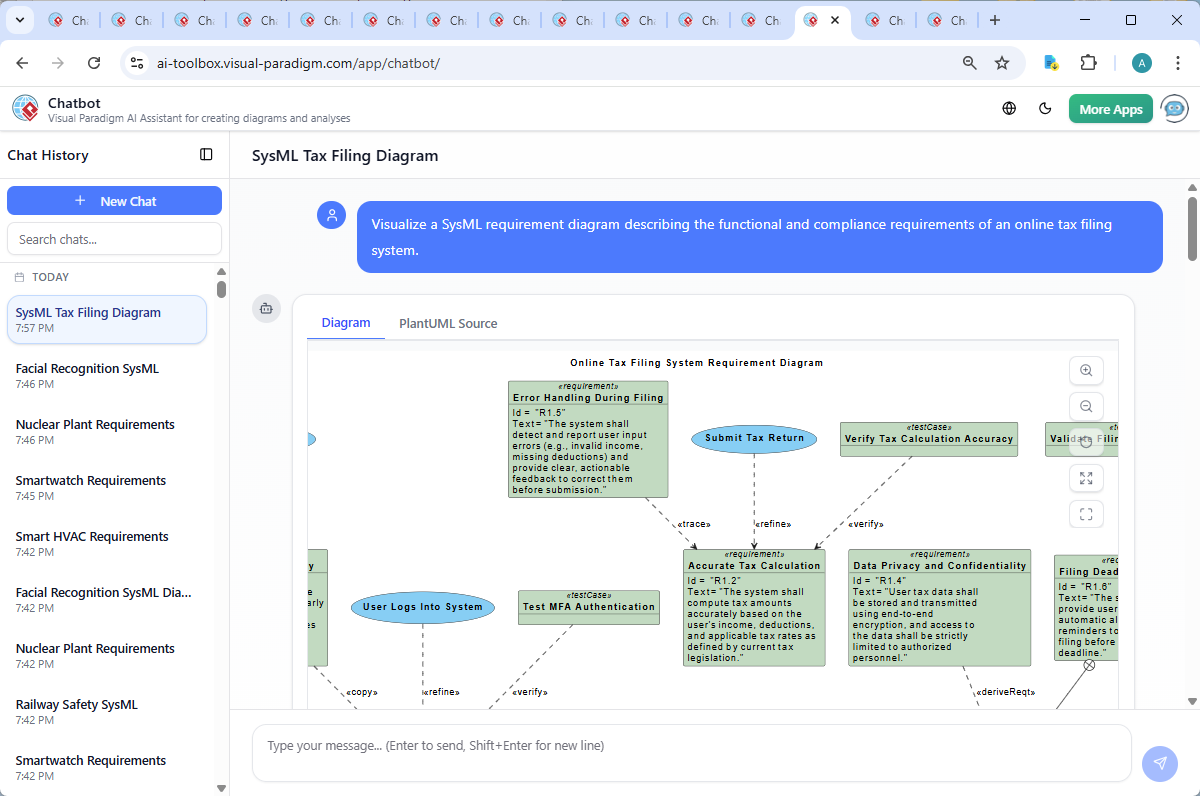
The process began with a simple prompt: “Visualize a SysML requirement diagram describing the functional and compliance requirements of an online tax filing system.” The AI Chatbot responded not with a static image, but with a fully structured PlantUML script—complete with traceability, relationships, and real-world context. This wasn’t just diagram generation; it was a design conversation.
When the user asked, “Explain this diagram,” the AI didn’t just list elements—it provided a layered breakdown, clarifying how each requirement connects to user actions, test cases, and compliance mandates. For instance, it explained that $deriveReqt(req04, req03) reflects the logical dependency: data privacy (req04) is derived from IRS compliance (req03), ensuring that privacy controls aren’t optional but mandated by regulation.
Further refinements followed naturally: “AI, refine the logic” led to the addition of $containment(req03, req07), showing that IRS compliance (req03) encompasses audit trail generation (req07), reinforcing the auditability requirement as part of the compliance framework. These iterative exchanges prove the AI’s ability to act as a modeling expert—adapting to feedback and deepening the design’s integrity.
Decoding the Logic: Why This Diagram Works
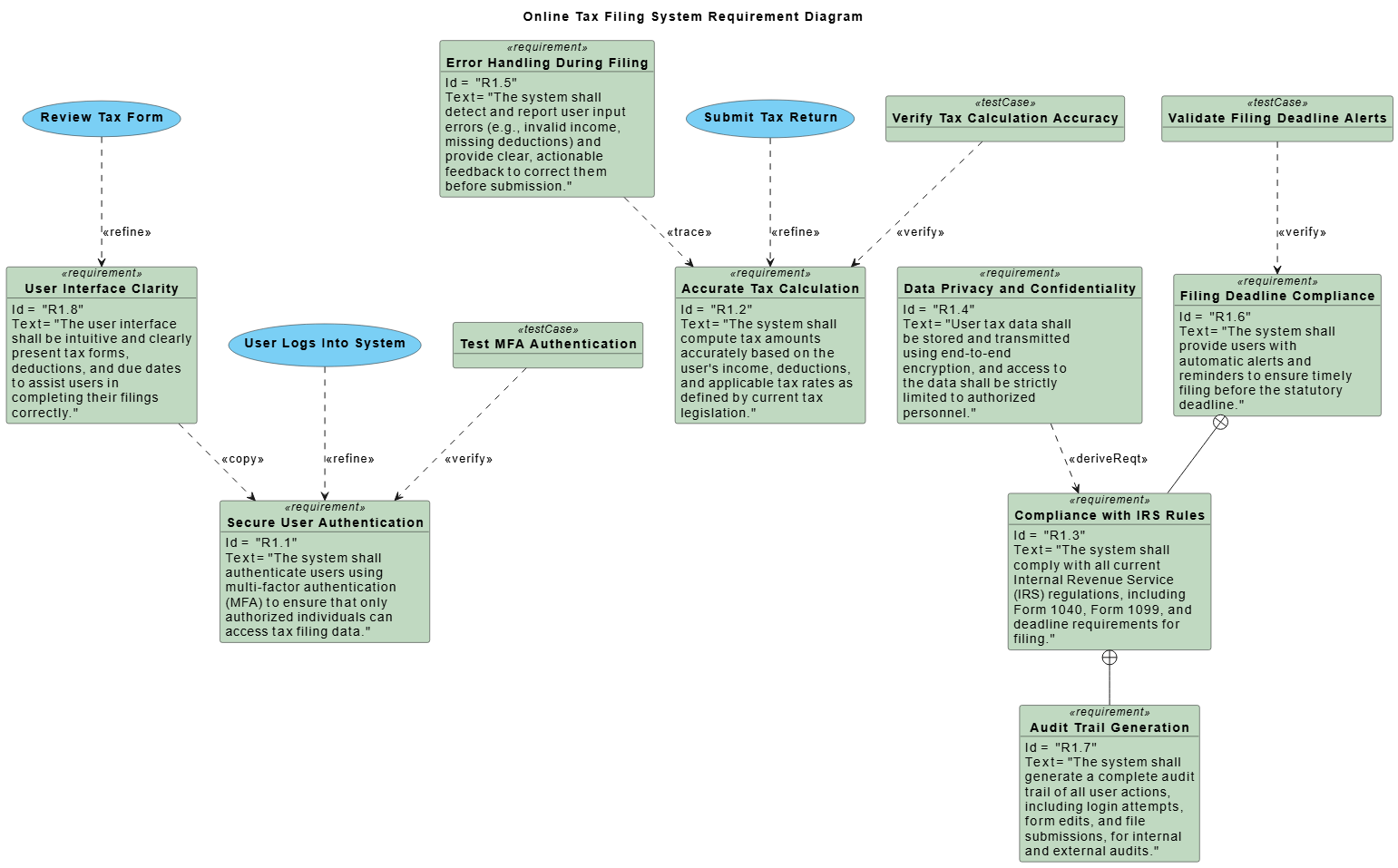
The generated SysML Requirement Diagram is more than a visual aid—it’s a living model of system intent. Here’s how each component contributes to a trustworthy tax platform:
Core Requirements: The Foundation of Trust
- req01 (Secure User Authentication): Mandates multi-factor authentication, ensuring only verified users access sensitive data.
- req02 (Accurate Tax Calculation): The system’s core function—computing taxes based on income, deductions, and current tax codes.
- req03 (Compliance with IRS Rules): Ensures alignment with Form 1040, Form 1099, and filing deadlines—non-negotiable for legal operation.
- req04 (Data Privacy & Confidentiality): Requires end-to-end encryption and strict access controls, protecting user data from breaches.
- req05 (Error Handling During Filing): Detects input errors early and guides users to fix them, reducing submission failures.
- req06 (Filing Deadline Compliance): Sends automated reminders to prevent late filings.
- req07 (Audit Trail Generation): Logs every user action for accountability during audits.
- req08 (User Interface Clarity): Ensures forms and deadlines are easy to understand, reducing user stress and errors.
Relationships That Tell the Story
The true power of this diagram lies in its traceability network:
$verify(testCase01, req02): The test case for tax accuracy directly validates the core calculation requirement.$refine(useCase01, req01): The login use case is refined by the MFA requirement, ensuring authentication is not an afterthought.$trace(req05, req02): Error handling is traced back to calculation accuracy—because input errors directly impact tax outcomes.$containment(req03, req07): IRS compliance includes audit trail requirements, showing that compliance isn’t just about forms—it’s about transparency.
These relationships form a requirements traceability matrix, enabling developers, auditors, and product managers to validate that every feature is rooted in a defined need.
Conversational Intelligence in Action
What sets the Visual Paradigm AI Chatbot apart is its ability to respond to follow-up queries with expert-level insight. When the user requested an explanation, the AI didn’t just describe elements—it contextualized them, showing how each requirement supports the system’s overall reliability and trustworthiness.
For example, the chatbot highlighted that $deriveReqt(req04, req03) isn’t arbitrary—it reflects real-world legal dependencies: privacy regulations often stem from broader compliance obligations. This level of contextual awareness elevates the AI from a diagram generator to a collaborative modeling consultant.
More Than Just SysML: A Full Modeling Suite
The Visual Paradigm AI Chatbot isn’t limited to SysML. It supports a full spectrum of modeling standards, making it a unified platform for enterprise and IT architecture:
- UML: For software design and system behavior modeling.
- ArchiMate: To map business, application, and technology layers in enterprise architecture.
- C4 Model: For visualizing software architecture at different levels of abstraction.
- Mind Maps, Org Charts, SWOT, PEST, PERT Charts: For strategic planning, organizational modeling, and project scheduling.
This versatility means teams can use the same AI-powered environment to model everything from user workflows to system architecture—ensuring alignment across business, design, and development teams.
Conclusion: Build with Confidence
The AI-generated SysML Requirement Diagram for the online tax filing system isn’t just a visualization—it’s a strategic blueprint. By combining regulatory rigor, user-centric design, and end-to-end traceability, it lays the foundation for a system that is secure, accurate, and compliant.
With the Visual Paradigm AI Chatbot, you’re not just generating diagrams—you’re co-designing with an intelligent partner that understands the why behind every requirement. Whether you’re building a financial service, a healthcare platform, or a government portal, this is how modern systems are designed: collaboratively, intelligently, and with full traceability.
Ready to turn your next idea into a traceable, compliant model? Try the shared session and experience the power of AI-driven visual modeling firsthand.