


Designing Trust: How AI Transforms Social Media Requirements into Actionable Models
Building a social media platform isn’t just about features—it’s about balancing user freedom with safety, privacy, and compliance. The challenge lies in translating complex, often conflicting demands—like enabling open expression while preventing harm—into a clear, traceable system of requirements. This is where the Visual Paradigm AI Chatbot steps in not as a tool, but as a collaborative modeling expert.
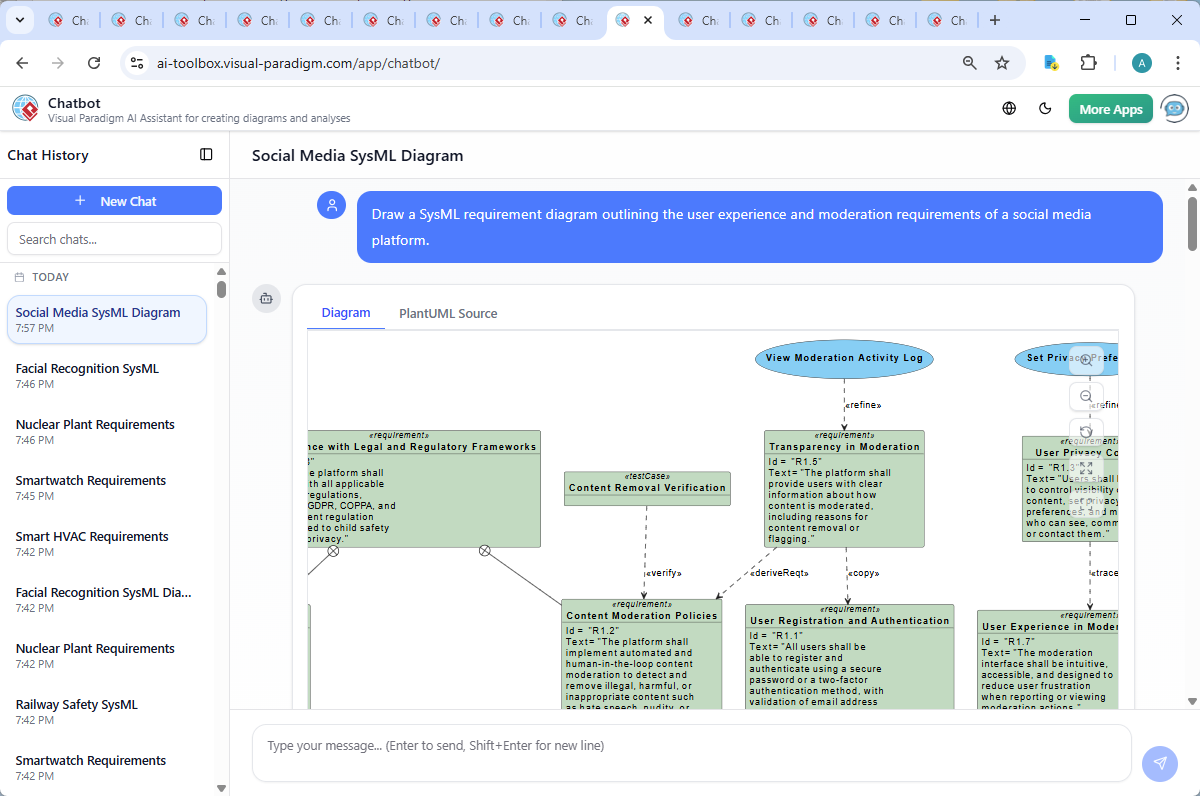
When the user prompted: “Draw a SysML requirement diagram outlining the user experience and moderation requirements of a social media platform,” the AI didn’t just generate a diagram—it began a conversation. It interpreted the intent, structured the requirements around real-world use cases, and built a traceable framework that connects user needs to system behavior and compliance.
From Prompt to Precision: The Evolution of a Requirement Diagram
The journey began with a simple request. The AI immediately responded with a structured PlantUML script using the sysml-requirement-diagram.puml library, generating a formal SysML Requirement Diagram with clear semantic relationships.
When the user asked, “Explain this diagram,” the AI didn’t offer a generic summary. Instead, it broke down each component with precision:
- It defined each requirement with its ID, priority, and real-world impact.
- It mapped use cases (e.g., “Report Harmful Content”) to their corresponding requirements.
- It explained how test cases verify requirements, and how relationships like
$verify,$deriveReqt, and$containmentestablish traceability and logical consistency.
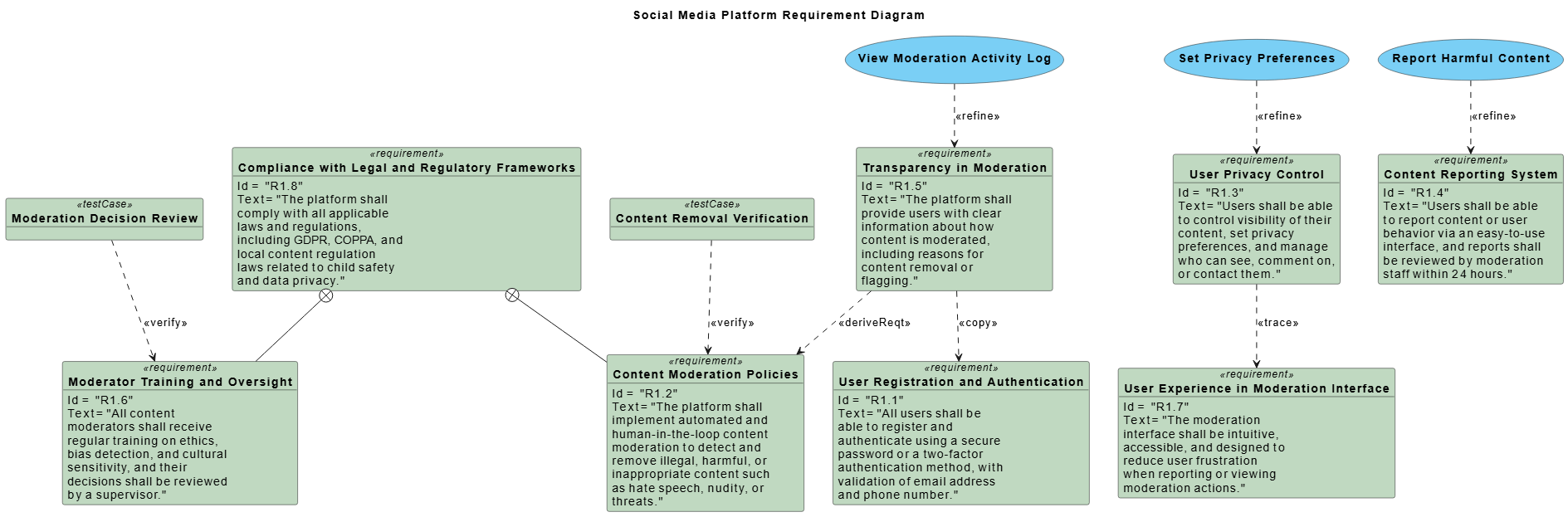
When the user requested clarification on a specific branch—“Explain this branch”—the AI didn’t default to a static explanation. It refined the logic, showing how $containment(req08, req02) ensures that legal compliance (R1.8) fully encompasses content moderation (R1.2), reinforcing that regulatory obligations aren’t optional add-ons—they’re foundational.
This wasn’t just explanation; it was collaborative design thinking. The AI acted as a modeling consultant, anticipating follow-up needs and proactively suggesting next steps—like integrating a system context diagram or generating a goal-realization view in ArchiMate.
Decoding the Diagram: The Logic Behind the Structure
The diagram is built on the core principles of SysML Requirement Modeling, but with a human-centered twist. Here’s how each element contributes:
1. Core Requirements (R1.1 to R1.8)
Each requirement is a measurable, verifiable statement. For example:
- R1.1 – User Registration & Authentication: Ensures secure onboarding with 2FA and identity validation.
- R1.2 – Content Moderation Policies: Mandates both automated detection and human review to handle nuanced content.
- R1.8 – Legal & Regulatory Compliance: Embeds GDPR, COPPA, and local laws directly into the system’s design.
2. Use Cases as Behavioral Anchors
Use cases like “Report Harmful Content” and “Set Privacy Preferences” serve as behavioral anchors. They show how users interact with the system and provide context for requirements. The $refine() relationship ensures that each use case is a concrete manifestation of a requirement.
3. Test Cases for Verification
Test cases such as “Content Removal Verification” and “Moderation Decision Review” aren’t afterthoughts—they’re built into the model as validation mechanisms. The $verify() relationship ensures that every requirement can be tested, reducing ambiguity in QA and compliance audits.
4. Traceability and Logical Dependencies
The diagram uses advanced SysML relationships to create a traceable, auditable chain:
$deriveReqt(req05, req02): Transparency (R1.5) is derived from content moderation (R1.2), showing that trust requires visibility.$containment(req08, req06): Legal compliance (R1.8) includes moderator training (R1.6), reinforcing that compliance isn’t just legal—it’s operational.$trace(req03, req07): Privacy controls (R1.3) are linked to the UX of the moderation interface (R1.7), ensuring that privacy settings don’t compromise usability.
This level of detail isn’t just about notation—it’s about ensuring that every decision is justified, traceable, and aligned with user and regulatory needs.
Conversational Intelligence: The AI as a Modeling Partner
What sets the Visual Paradigm AI Chatbot apart is its ability to engage in a deep, iterative dialogue. The user didn’t just get a diagram—they got a conversation that evolved the model in real time.
After the initial generation, the user asked for an explanation. The AI didn’t just describe the diagram—it diagnosed the intent behind each element, showing how relationships like $containment prevent regulatory gaps and how $trace ensures that privacy features are not siloed from the user experience.
When the user requested clarification on a specific branch, the AI didn’t restate the diagram—it restructured the explanation around intent and impact, revealing that R1.8 isn’t just a legal requirement—it’s a foundational layer that permeates all other requirements.
This isn’t automation. It’s AI-powered design collaboration. The chatbot doesn’t just generate diagrams—it understands the why behind the structure, the how of traceability, and the what of user trust.
Beyond SysML: A Unified Modeling Platform
The Visual Paradigm AI Chatbot isn’t limited to SysML. It seamlessly supports a full suite of modeling standards:
- UML: For system architecture, component design, and behavior modeling.
- ArchiMate: For enterprise architecture, showing how business goals, applications, and technology align.
- C4 Model: For clear, scalable software architecture visualization (Context, Containers, Components, Code).
- Mind Maps, Org Charts, PEST, SWOT: For strategic planning, stakeholder analysis, and business modeling.
- PERT Charts, Charts (column, pie, line, area): For project scheduling and data visualization.
Whether you’re designing a user journey in UML, mapping enterprise goals in ArchiMate, or visualizing content moderation workflows in C4, the AI Chatbot adapts to your needs—acting as a consistent, intelligent modeling partner across all standards.
Conclusion: Where AI Meets Design Integrity
The Social Media Platform Requirement Diagram is more than a visual artifact—it’s a living blueprint for trust, safety, and compliance. By leveraging the Visual Paradigm AI Chatbot, teams can move beyond guesswork and static diagrams to a dynamic, conversation-driven modeling process.
From the initial prompt to the final traceable structure, the AI didn’t just deliver a diagram—it guided the design process, ensuring clarity, consistency, and compliance at every step.
Ready to turn your next idea into a fully traceable, AI-validated model? Explore the shared session and see how the AI Chatbot transforms your vision into a precise, actionable model.