


Designing a Unified Cloud CRM Ecosystem: From Idea to Architectural Precision
Building a scalable, integrated cloud-based CRM system that supports sales, marketing, and customer support demands more than just technical implementation—it requires a clear architectural vision. The challenge lies in modeling how data, services, and applications interact across business functions while maintaining clarity, traceability, and alignment with enterprise goals.
Enter the Visual Paradigm AI Chatbot—not just a diagram generator, but a collaborative modeling expert. It transforms natural language prompts into structured, standards-compliant ArchiMate diagrams through a conversational design process. This isn’t about automating static visuals; it’s about co-creating intelligent architecture with real-time feedback and expert insight.
From Prompt to Precision: A Collaborative Design Journey
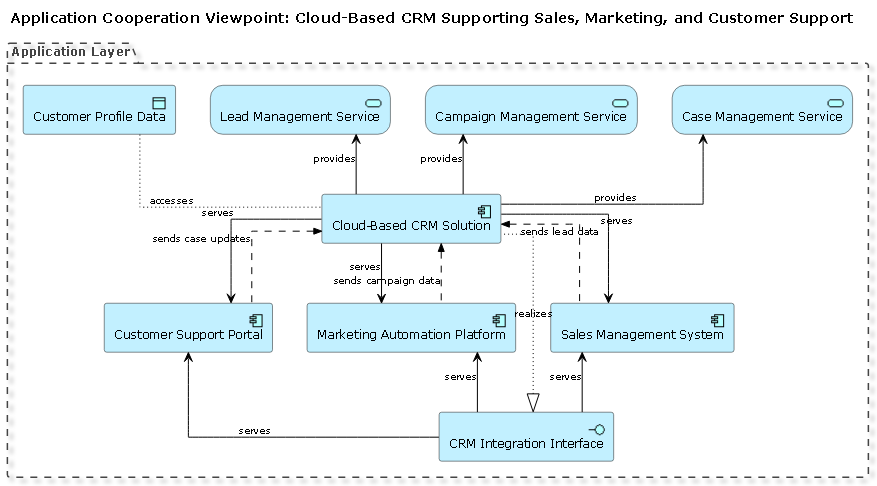
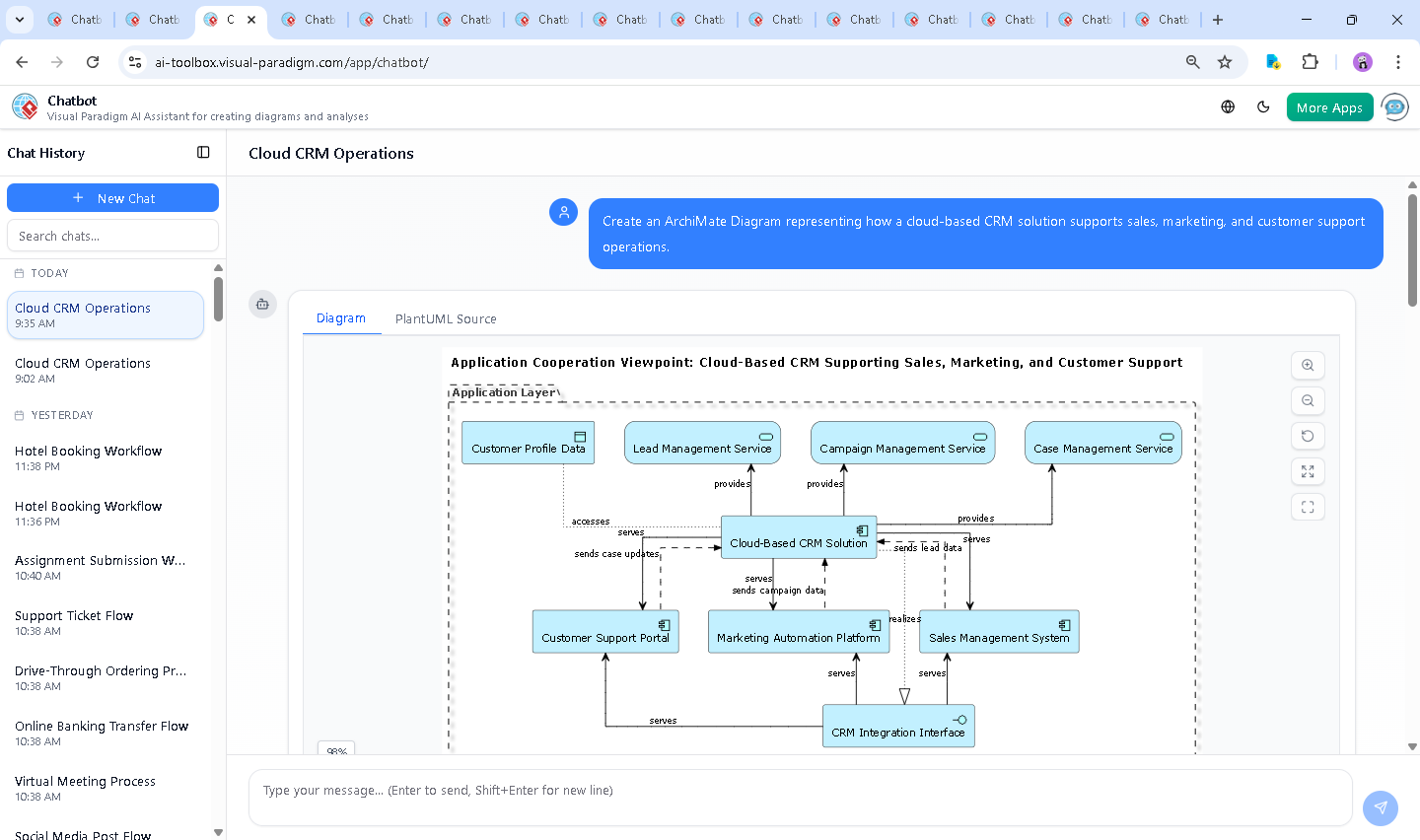
The journey began with a simple request: “Create an ArchiMate Diagram representing how a cloud-based CRM solution supports sales, marketing, and customer support operations.” Within seconds, the AI Chatbot responded with a fully rendered PlantUML script, generating a clear Application Cooperation Viewpoint that visualized the core components and their relationships.
But the real value emerged in the follow-up. When asked, “Can you explain how the Lead Management Service integrates with the sales workflow in the CRM?”, the AI didn’t just restate the diagram—it expanded the narrative with a detailed, functionally grounded explanation. It broke down the flow from lead capture to qualification, assignment, and integration into the sales pipeline, highlighting how the CRM acts as an active enabler, not just a data store.
This wasn’t a one-way output. The conversation revealed the AI’s ability to:
- Interpret business intent behind technical terms.
- Explain architectural decisions using real-world workflows.
- Offer additional modeling formats (e.g., sequence or block diagrams) when requested.
Each response refined the model’s context, turning a static diagram into a living design artifact shaped by user inquiry and AI intelligence.
Decoding the Architecture: The Logic Behind the Diagram
The generated ArchiMate diagram centers on the Cloud-Based CRM Solution as the central application, serving three key business functions: Sales, Marketing, and Customer Support. The structure follows the ArchiMate Application Layer, using standard elements and relationships to convey both functional and structural logic.
Core Components and Their Roles
- CRM_Application: The central hub that hosts all customer-facing services and data.
- Sales_Application, Marketing_Application, Support_Application: Specialized systems that leverage the CRM for their respective operations.
- Customer_Data: A shared data object representing unified customer profiles, ensuring consistency across departments.
- Lead_Management_Service, Campaign_Management_Service, Case_Management_Service: Core services within the CRM that automate key business processes.
- CRM_Interface: A standardized interface enabling seamless integration with external systems.
Relationships That Define the Flow
Each relationship in the diagram is purposefully chosen to reflect real-world interactions:
- Rel_Serving_Up: Indicates that the CRM provides services to other applications (e.g., CRM serves Sales Application).
- Rel_Access_Up: Shows data access—CRM Application accesses Customer Data.
- Rel_Realization_Up: Demonstrates that the CRM Application realizes the CRM_Interface.
- Rel_Flow_Up: Captures data flow from external systems to the CRM (e.g., lead data from Sales Application).
This layered approach ensures that the diagram is not just visually clean, but semantically accurate—perfect for stakeholder alignment, system design, and future development planning.
Conversational Intelligence in Action
What makes this process transformative is the AI’s role as a modeling consultant. After the initial diagram, the user asked for a deeper explanation of the Lead Management Service’s integration with sales. The AI responded not with a diagram, but with a narrative that:
- Explained the lead lifecycle from capture to conversion.
- Highlighted business value—like improved lead qualification and forecasting.
- Offered to generate alternative diagrams (e.g., sequence or SysML) if needed.
This back-and-forth demonstrates how the AI doesn’t just produce visuals—it engages in architectural reasoning, adapting to user needs and enriching the design with context.
Beyond ArchiMate: A Full-Stack Modeling Platform
The Visual Paradigm AI Chatbot isn’t limited to ArchiMate. It supports a full spectrum of modeling standards, including:
- UML: For software design and system behavior modeling.
- SysML: For systems engineering and complex system analysis.
- C4 Model: For software architecture visualization at different abstraction levels.
- Mind Maps: For idea structuring.
Whether you’re designing a microservices architecture, mapping business processes, or visualizing enterprise systems, the AI Chatbot adapts to your needs—acting as a consistent, intelligent partner across all modeling disciplines.
Conclusion: Architecting with Confidence
Visual Paradigm’s AI Chatbot turns architectural design from a manual, iterative task into a dynamic conversation. By combining natural language input with deep modeling expertise, it empowers teams to explore, refine, and validate complex systems—like a cloud-based CRM—faster and more accurately.
With the ability to generate, explain, and evolve diagrams through dialogue, Visual Paradigm isn’t just a tool—it’s a collaborative design environment where ideas become precise, actionable models.
Ready to build your next enterprise architecture? Start your conversation today and see how the AI Chatbot can bring your vision to life.