


Designing a Secure Digital Wallet: How AI Transforms System Architecture
Building a digital wallet system demands more than just coding—it requires a clear, structured understanding of its core components and how they interact. The challenge lies in defining the right building blocks while ensuring scalability, security, and interoperability. This is where the Visual Paradigm AI Chatbot steps in—not as a passive tool, but as an active modeling collaborator.
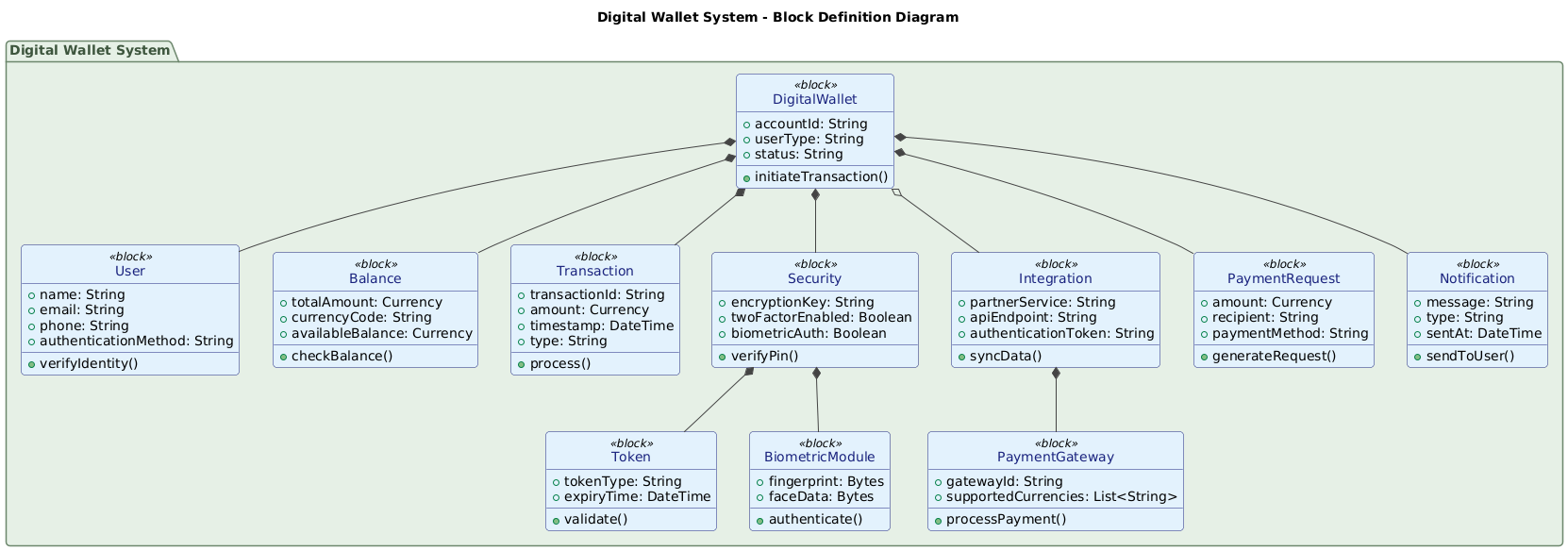
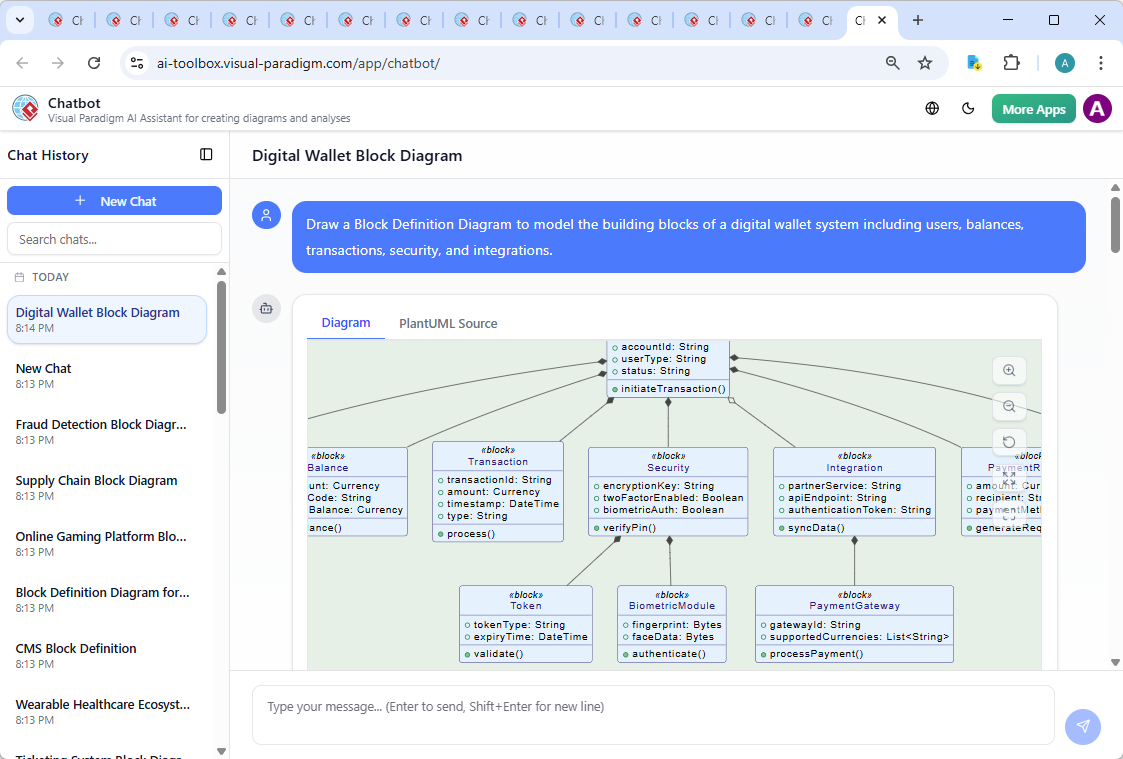
Instead of starting from scratch, the user simply shared a vision: “Draw a Block Definition Diagram to model the building blocks of a digital wallet system including users, balances, transactions, security, and integrations.” Within seconds, the AI generated a precise SysML Block Definition Diagram using PlantUML syntax, demonstrating how natural language prompts can be instantly translated into professional-grade visual models.
From Prompt to Precision: The Evolution of the Diagram
The journey began with a simple request. The AI responded with a fully structured BlockDefinitionDiagram that captured the essential elements of a digital wallet system. But the real value emerged in the conversation that followed.
When the user asked, “Explain this diagram,” the AI didn’t just restate the code—it provided a deep, layered breakdown of the system’s architecture. It clarified the relationships between blocks, explained the significance of multiplicity (like *-- and o--), and contextualized each component within real-world use cases.
For example, the AI highlighted that the Security block isn’t just a placeholder—it’s a critical layer that includes BiometricModule and Token sub-components, showing how multi-factor authentication is implemented at the design level. It also explained how Integration is an optional, external-facing connection—perfect for linking with third-party services like payment gateways.
When the user later asked for refinements, the AI responded with intelligent suggestions: “Would you like to extend it with sequence diagrams or security flow?” This proactive guidance reflects the AI Chatbot’s role as a modeling expert, not just a diagram generator.
Decoding the Logic: Why This Diagram Works
The generated Block Definition Diagram is more than a visual—it’s a foundational blueprint for system design. Let’s walk through its core logic:
Core Blocks and Their Roles
- DigitalWallet: The central container. It owns references to
User,Balance,Transaction,Security, andIntegration. - User: Holds identity data and authentication methods. Key for access control.
- Balance: Tracks available and total funds, supporting multiple currencies.
- Transaction: Records all financial actions with metadata (timestamp, type, amount).
- Security: Enforces encryption, two-factor authentication, and biometric verification.
- Integration: Enables connections with external services (e.g., banks, payment gateways).
Relationships That Matter
DigitalWallet *-- User: A wallet can serve many users, but each user belongs to one wallet.DigitalWallet *-- Balance: Each wallet has one or more balance records (e.g., USD, EUR).DigitalWallet o-- Integration: Integration is optional—used only when connecting to external systems.Security *-- BiometricModule: Security includes biometric authentication as a sub-component.Integration *-- PaymentGateway: External gateways handle actual transaction processing.
The use of Block stereotypes in SysML is intentional: it emphasizes the system’s modular, hierarchical nature—perfect for complex systems like digital wallets where components are both autonomous and interdependent.
Conversational Intelligence: The AI as Your Modeling Partner
What sets the Visual Paradigm AI Chatbot apart is its ability to engage in a collaborative design dialogue. The chat history shows how the AI didn’t just output code—it interpreted intent, explained context, and anticipated next steps.
For instance, after the initial diagram was generated, the user requested an explanation. The AI didn’t just list components—it provided a structured breakdown with use cases, relationship meanings, and architectural insights. When asked to refine or expand, it offered targeted suggestions: sequence diagrams, security flows, or export formats.
This level of interaction transforms the tool from a diagramming app into a conversational design environment, where every question leads to deeper clarity.
Beyond Blocks: A Unified Modeling Platform
While this example focused on a SysML Block Definition Diagram, the Visual Paradigm AI Chatbot is not limited to one standard. It supports a full suite of modeling languages, including:
- UML: For software design and system behavior.
- ArchiMate: For enterprise architecture and business-IT alignment.
- C4 Model: For software architecture at different abstraction levels.
- SWOT, PEST, Org Chart, Mind Map, PERT Chart: For strategic planning and organizational modeling.
Whether you’re designing a fintech platform, mapping business processes, or visualizing IT infrastructure, the AI Chatbot adapts to your needs—delivering accurate, professional diagrams across standards.
Conclusion: Your System, Visualized with Intelligence
Creating a digital wallet system is no small task. But with the Visual Paradigm AI Chatbot, you don’t need to be a modeling expert to produce enterprise-grade diagrams. The platform turns natural language into precise, structured visual models—complete with intelligent explanations and continuous refinement through conversation.
Whether you’re a developer, architect, or product manager, the AI Chatbot acts as your co-designer, helping you build, explain, and evolve your system with confidence.
Ready to model your next system? Explore the shared session and see how the AI transforms ideas into models—fast, smart, and collaborative.