


Designing an E-Commerce Fulfillment & Returns System: An AI-Powered Journey Through Business Process Diagrams
Building an efficient, scalable e-commerce operation requires more than just high sales—it demands absolute operational clarity. The main challenge lies in mapping how an order moves seamlessly across departments, from payment verification to warehouse picking, carrier handoffs, and customer returns. That’s where the Visual Paradigm AI-Powered Chatbot steps in—not as a basic diagramming tool, but as a collaborative operational modeling partner.
From Prompt to Precision: The Conversational Evolution of the Process
The workflow started with a simple operational goal:
“Visualize a business process diagram for an online order fulfillment system, including payment verification, warehouse picking, inventory updates, shipping, and handling out-of-stock items.”
The AI Chatbot generated a clear BPMN-compliant Business Process Diagram using structured swimlanes, gateway decisions, and event triggers.
To refine the workflow further, a follow-up request was made:
“Can you add a parallel customer return and refund approval subprocess when an order is marked as damaged or unwanted?”
Instead of simply adding a isolated box, the AI integrated a structured return loop. It mapped out the customer request phase, automated inspection checks, warehouse restocking routines, and finance department refund approvals—complete with timing triggers and conditional rules.
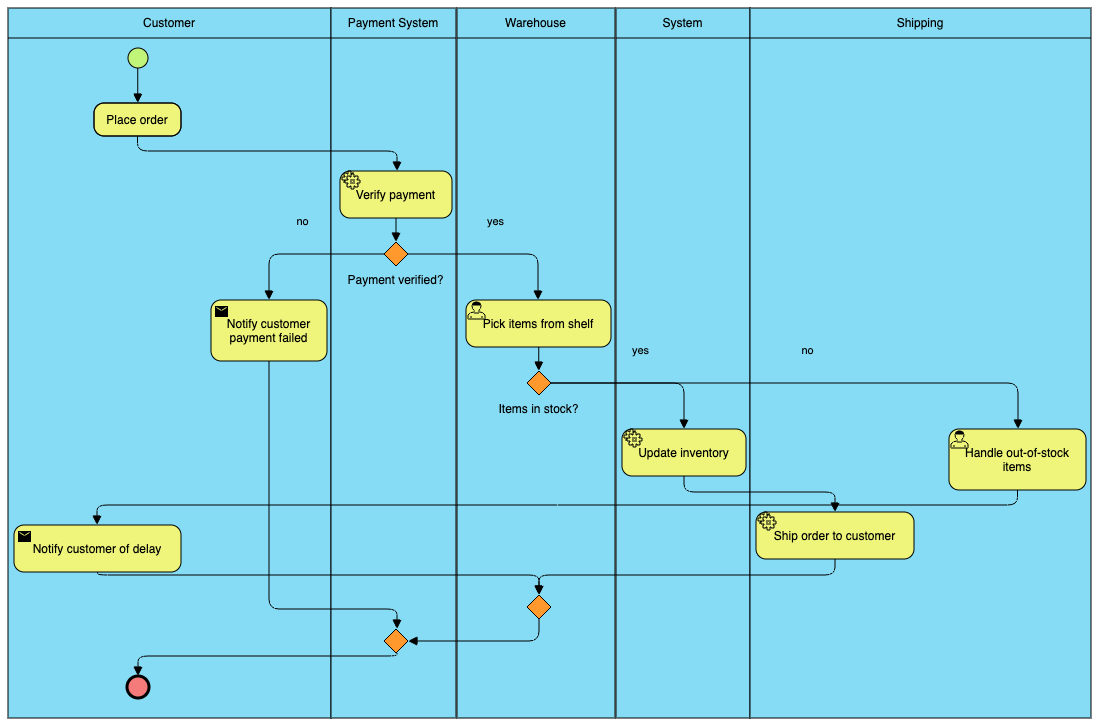
Business Process Diagram: Order Fulfillment & Returns Architecture
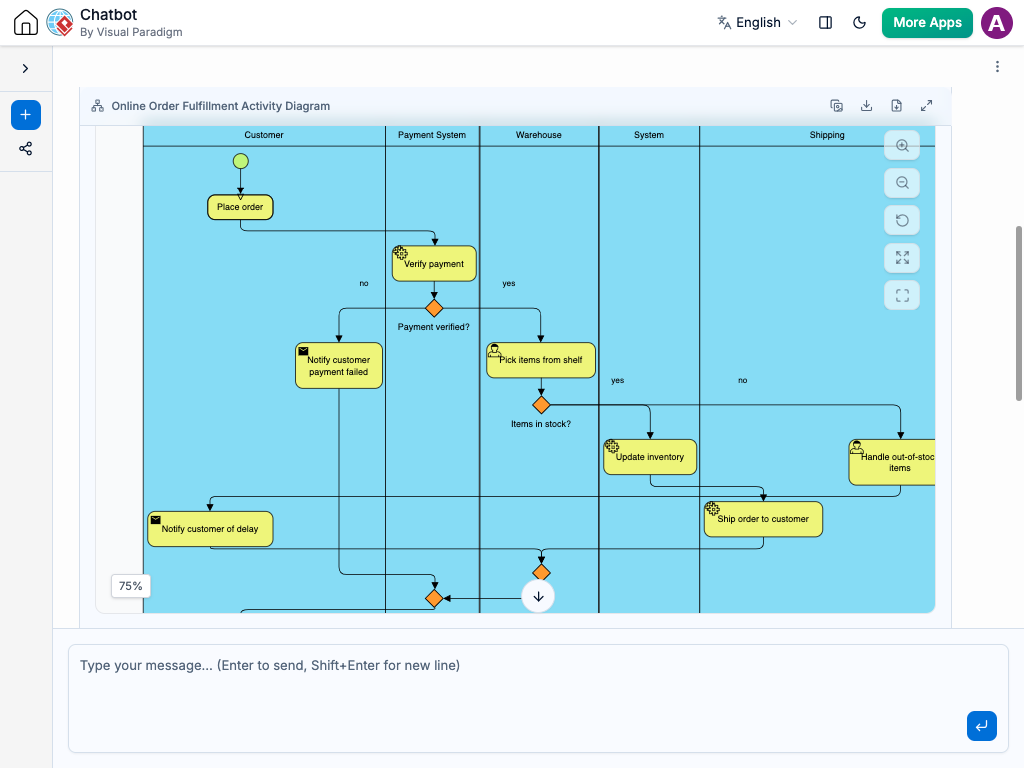
The generated Business Process Diagram provides a comprehensive view of the end-to-end lifecycle, organized into five functional swimlanes:
-
Customer: Initiates the order, tracks delivery status, and submits return requests.
-
Payment Gateway & Finance: Handles transaction authorization, fraud checks, and issuing customer refunds.
-
Warehouse & Inventory: Manages stock verification, item picking, packing, and restocking returned goods.
-
Shipping & Logistics: Coordinates carrier pickup, package dispatch, and delivery confirmations.
-
Customer Support: Reviews exception cases, manual return overrides, and out-of-stock escalations.
Logic Breakdown: Why This BPMN Structure Works
Using standard Business Process Model and Notation (BPMN) principles ensures that operational teams, developers, and management read the exact same source of truth.
-
Swimlane Accountability: Separates tasks clearly by team or system, preventing confusion over who owns specific steps (e.g., automated payment vs. human warehouse packing).
-
Exclusive Gateways (XOR): Handles binary decision paths efficiently, such as Payment Approved vs. Payment Failed or Item in Stock vs. Out of Stock.
-
Parallel Gateways (AND): Shows tasks happening simultaneously—like updating inventory levels while generating a shipping label at the same time.
-
End-to-End Exception Handling: Maps out edge cases directly into the process flow so teams know exactly what happens during backorders, lost packages, or returned merchandise.
Conversational Intelligence: Beyond Static Flowcharts
The Visual Paradigm AI Chatbot transforms static process mapping into a dynamic design experience. When asked to optimize the process for faster delivery times, the AI provided:
-
Bottleneck Analysis: Highlighted delays during manual inventory checks and suggested automated barcode scanning triggers.
-
SLA & Timing Guidelines: Defined target turnaround times for each phase (e.g., 2-hour window from payment to warehouse pick list generation).
-
Integration Points: Mapped where API connections occur between the e-commerce storefront, ERP system, and shipping carrier portals.
Platform Versatility: One AI, Multiple Standards
While this page focuses on Business Process Diagrams (BPMN), the Visual Paradigm AI Chatbot supports a comprehensive set of diagramming frameworks:
-
UML Diagrams: Class, Sequence, Component, and Activity diagrams for software architecture.
-
Enterprise Architecture: ArchiMate frameworks mapping business, application, and technology layers.
-
Systems Engineering: SysML diagrams for requirements, paramatrics, and complex hardware-software integration.
-
Strategic Business Models: Mind Maps, SWOT, Pestle, BCG Matrix, and Value Stream Maps.
Deeper Exploration: Process Optimization & Workflow Guides
To expand your operational modeling toolkit, check out these related guides and resources:
-
BPMN Orchestration vs. Choreography: Understand when to use simple workflows versus complex multi-organization processes.
-
Swimlane Diagram Best Practices: Tips for organizing multi-department responsibilities clearly.
-
Value Stream Mapping: Learn how to analyze your business process to eliminate operational waste.
Streamline Your Business Processes Today
Designing efficient business processes doesn’t have to mean spending hours dragging boxes and connecting arrows. The Visual Paradigm AI Chatbot acts as your operational analyst, helping you build clear, actionable process diagrams through plain language.
Ready to map your business processes? Try the AI Chatbot and turn your operational workflows into clear visual diagrams.