


Work Breakdown Structure (WBS)
A Work Breakdown Structure (WBS) decomposes a complex project into smaller, manageable deliverables and work packages to organize scopes and assign responsibilities effectively.
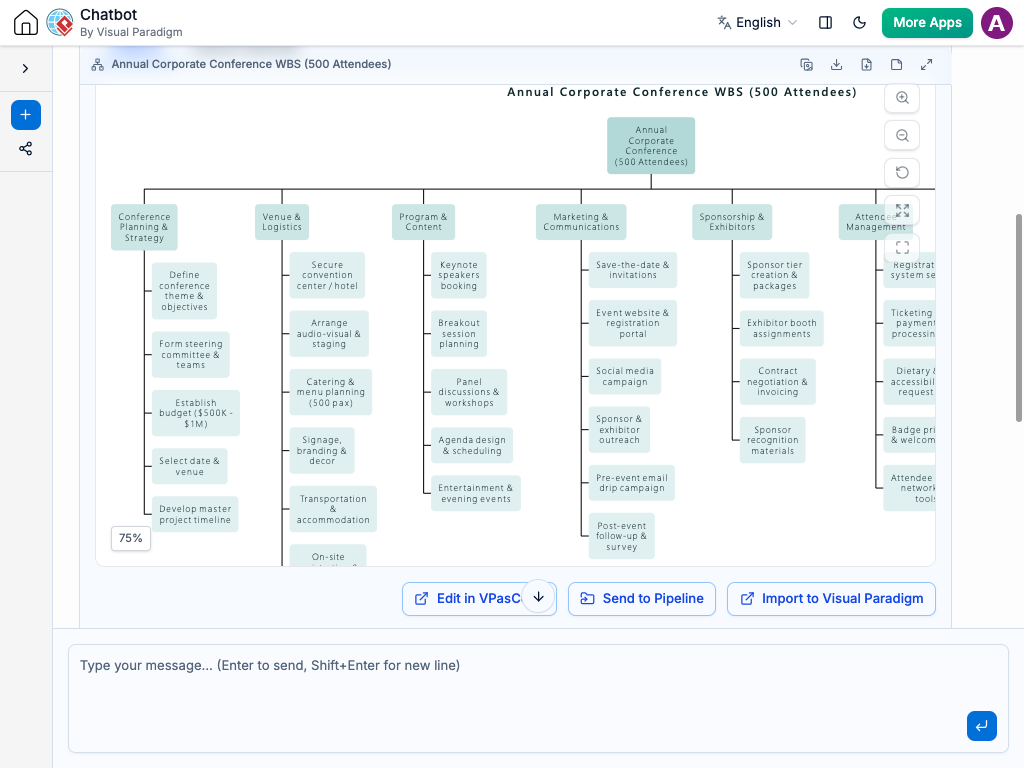
Instant WBS Creation
Breaking down large project scopes into structured, manageable components shouldn’t require tedious box drawing and manual hierarchy tree mapping. Instead of manually arranging level blocks, parent-child branches, and work packages, you can simply describe your project scope to the AI Chatbot.
The system translates your project goals into a clean, hierarchical Work Breakdown Structure. It automatically divides the overall project into major phases, key deliverables, and individual work items using standard WBS numbering. Whether you are managing a software release, a construction project, or a marketing campaign, you get a clear structural breakdown in seconds.
Refine Project Scopes Through Conversation
Adjusting project deliverables and expanding work phases is effortless using plain language. You can easily tweak your project hierarchy directly inside the chat interface by entering requests like:
Add deliverables or tasks: “Add a ‘Security Audit’ sub-deliverable under Phase 3: Testing.”
Reorganize levels: “Group all design tasks into a new top-level phase called ‘UI/UX Design Strategy’.”
Add work package details: “Assign task IDs 1.1.1 through 1.1.4 to the frontend engineering deliverable.”
The diagram updates instantly, automatically realigning parent-child connections and renumbering WBS codes so your project scope remains clear and organized.


Standard Hierarchical Tree Layout: Renders industry-standard WBS structures with clear top-down visual relationships.
Automated WBS Coding: Automatically generates hierarchical numbering schemes (e.g., 1.0, 1.1, 1.1.1) for precise tracking.
100% Scope Coverage: Helps project managers ensure every project deliverable and milestone is accounted for without missing critical sub-tasks.
Streamlined Task Delegation: Makes it easy to assign clear ownership for specific work packages across engineering and operations teams.
Examples of Generating WBS Diagrams
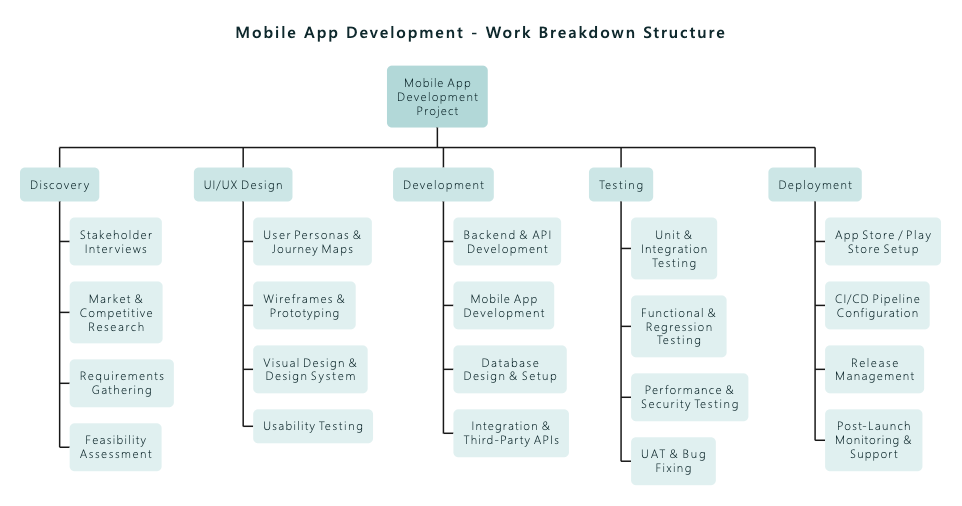
“Generate a 3-level Work Breakdown Structure for a mobile app development project, covering Discovery, UI/UX Design, Development, Testing, and Deployment.”
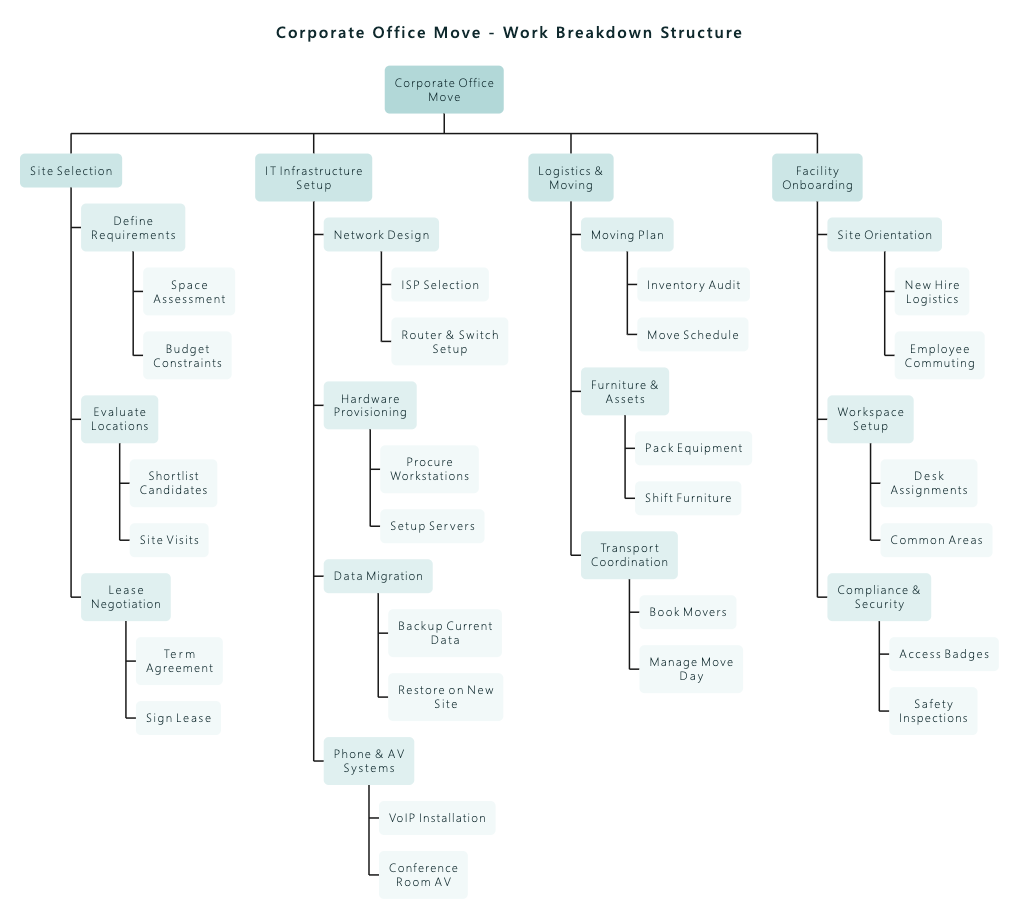
“Create a WBS diagram for a corporate office move, splitting tasks across Site Selection, IT Infrastructure Setup, Logistics & Moving, and Facility Onboarding.”
Annual Marketing Campaign Launch
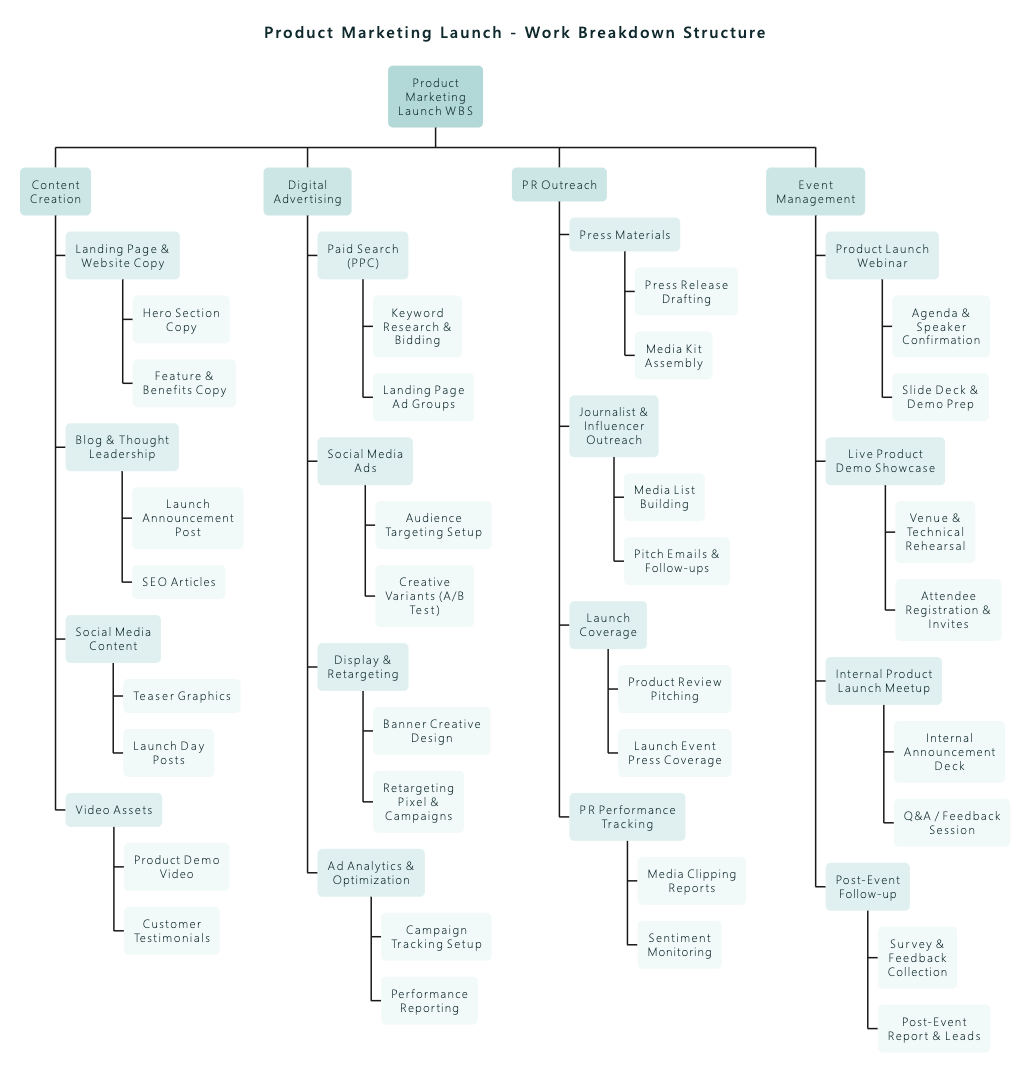
“Create a Work Breakdown Structure for a product marketing launch, covering Content Creation, Digital Advertising, PR Outreach, and Event Management.”
What is a Work Breakdown Structure?
A Work Breakdown Structure (WBS) is a deliverable-oriented hierarchical decomposition of a project into smaller components. It breaks a large project down into manageable levels—starting from the total project scope at the top, down to major phases, deliverables, and discrete work packages at the lowest level.
WBS diagrams are widely used by project managers, Scrum masters, system engineers, and business leaders to define project boundaries, estimate costs and resource needs, and establish clear project baselines.
Key Concepts
Project Root
The top-level node representing the entire overall project scope (Level 1).
Control Accounts / Phases
High-level operational divisions or project stages that group related deliverables (Level 2).
Deliverables
Tangible, verifiable outcomes or products produced during a project phase (Level 3).
Work Packages
The lowest level of the WBS containing specific, actionable tasks assigned to individual team members or units.
WBS Code / Dictionary
A structured numbering system assigned to each node to uniquely identify and track work items throughout the project lifecycle.