


Core Elements of the Online Shopping Cart and Checkout Workflow
Designing a seamless online shopping experience begins with a clear understanding of how users interact with the cart and checkout process. Visual Paradigm’s AI Activity Diagram generator transforms high-level business logic into precise, actionable diagrams—making it easier for teams to visualize, refine, and implement user journeys. This AI-powered modeling approach eliminates the complexity of manual diagramming, enabling rapid prototyping of critical workflows like cart management and checkout.
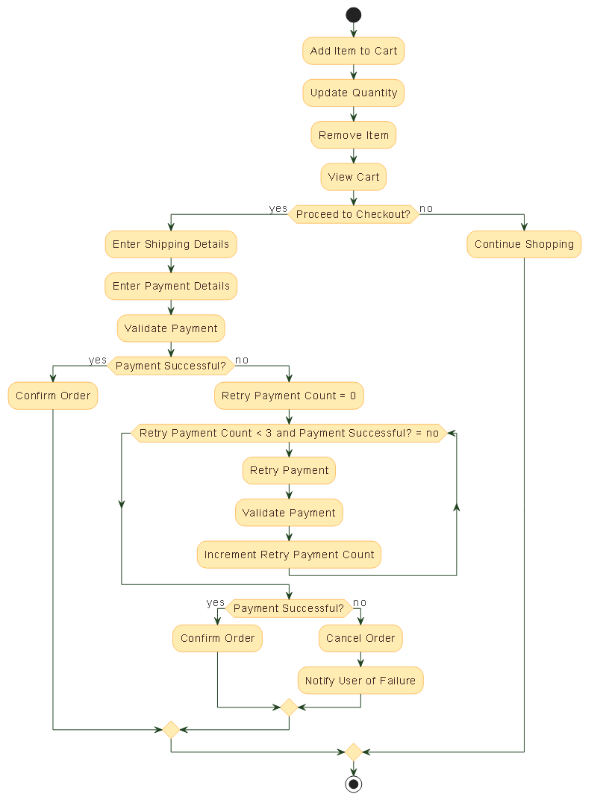
The diagram below captures the full lifecycle of an online shopping session, from adding items to final order confirmation. It’s not just a visual map—it’s a living blueprint of system behavior, crafted using the Visual Paradigm AI Chatbot. Every decision point, loop, and flow is designed to reflect real-world user interactions, ensuring that development teams build systems that are both intuitive and resilient.
Understanding Real-Time Cart Management
One of the most critical aspects of modern e-commerce is real-time cart synchronization. When a user adds, removes, or updates an item, the system must reflect these changes instantly—without requiring a page refresh. This isn’t just a UX enhancement; it’s a fundamental expectation in today’s digital shopping landscape.
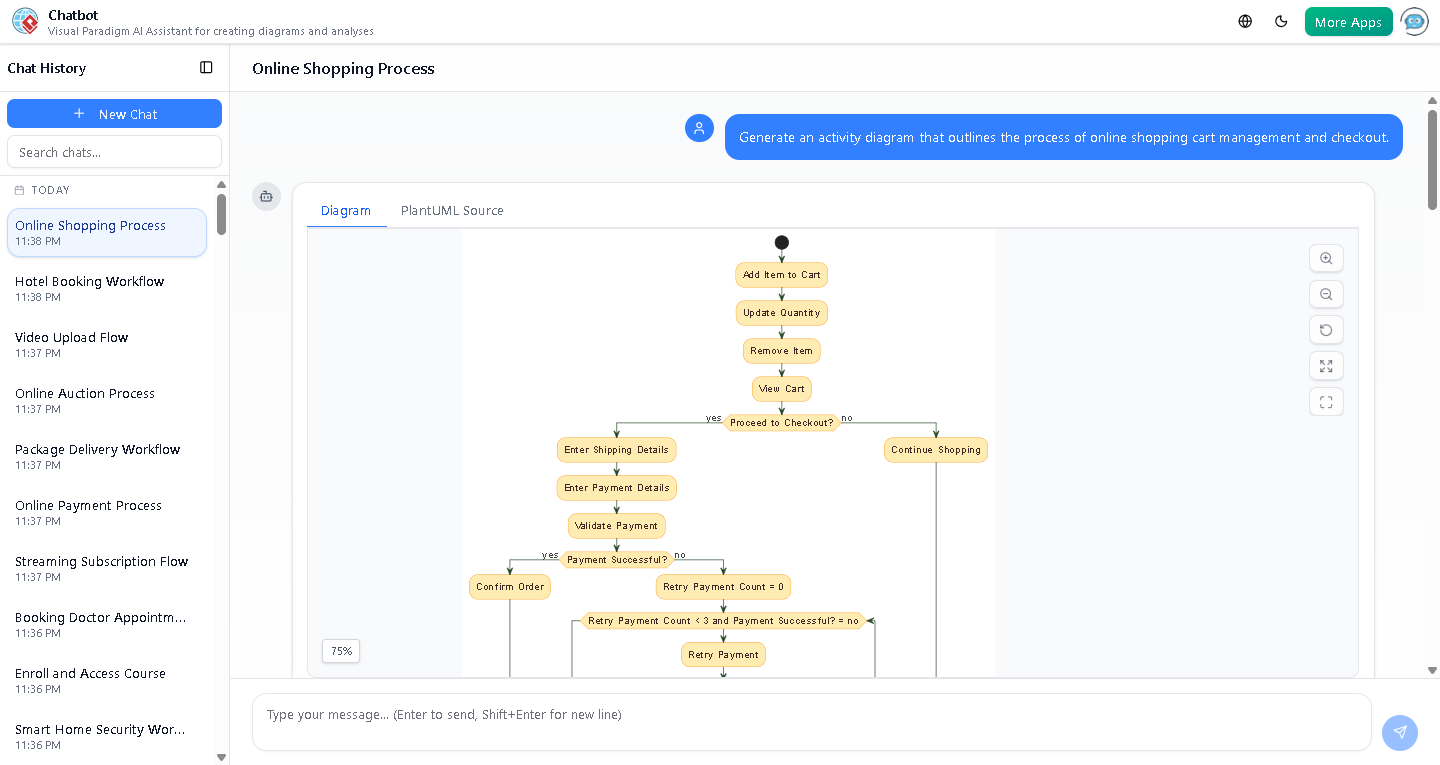
Through our conversation, the user asked: “Can you explain how the cart updates are reflected in real-time during the shopping process?” The AI responded with a detailed breakdown of the technical flow, highlighting how client-side JavaScript, server-side APIs, and real-time communication protocols like WebSockets work together to maintain cart consistency.
For example, when a user clicks “Add to Cart,” a request is sent via AJAX to the backend. The server validates inventory, updates the cart state, and returns the new data. The frontend then immediately updates the UI with the new total, item count, and any applied discounts—creating a fluid, responsive experience.
This real-time behavior is not just a feature—it’s embedded into the diagram’s logic. The “Update Quantity” and “Remove Item” actions are not isolated steps; they trigger immediate state changes that influence downstream decisions, such as checkout eligibility and payment validation.
Robust Error Handling and Retry Logic
One of the standout features of this activity diagram is its intelligent handling of payment failures. The system doesn’t simply fail and exit—it implements a retry mechanism with clear limits.
After a payment attempt fails, the system initializes a retry counter and enters a loop that allows up to three attempts. Each retry involves re-entering payment details, validating the transaction, and incrementing the counter. Only after three unsuccessful attempts does the system cancel the order and notify the user of failure.
This design prevents infinite loops while giving users a reasonable chance to correct errors—such as expired cards or insufficient funds—without abandoning their entire shopping session. It’s a practical balance between user experience and system integrity.
Why Visual Paradigm Stands Out in AI-Powered Modeling
Visual Paradigm, the comprehensive AI-powered visual modeling platform, goes beyond generating static diagrams. The AI Chatbot understands context, adapts to user questions, and enhances diagrams through natural conversation. In this case, the initial request for an activity diagram evolved into a deeper exploration of real-time cart behavior—demonstrating the tool’s ability to support both high-level design and technical implementation.
With support for multiple modeling standards—including UML, ArchiMate, SysML, C4, and mind maps—Visual Paradigm enables teams to model systems at every level of abstraction. Whether you’re designing a user journey, mapping enterprise architecture, or validating system logic, the AI Chatbot streamlines the process with intelligent suggestions, auto-completion, and dynamic editing.
Need to refine the diagram? Simply ask: “Add a step for guest checkout” or “Translate this into a sequence diagram.” The AI adapts instantly, making it the logical next step for any team building digital products with precision and speed.
Start designing your next workflow with the Visual Paradigm AI Chatbot →