


Designing a Seamless ERP Launch: How AI Collaborates on Your PERT Chart
Implementing an enterprise-wide ERP system across a multinational organization is a complex, high-stakes endeavor. The success of such a project hinges not just on technology, but on precise planning, clear dependencies, and disciplined execution. Traditional planning methods often fall short when managing interdependencies across multiple departments, time zones, and legacy systems. That’s where the Visual Paradigm AI Chatbot steps in—not as a mere diagram generator, but as a collaborative modeling partner.
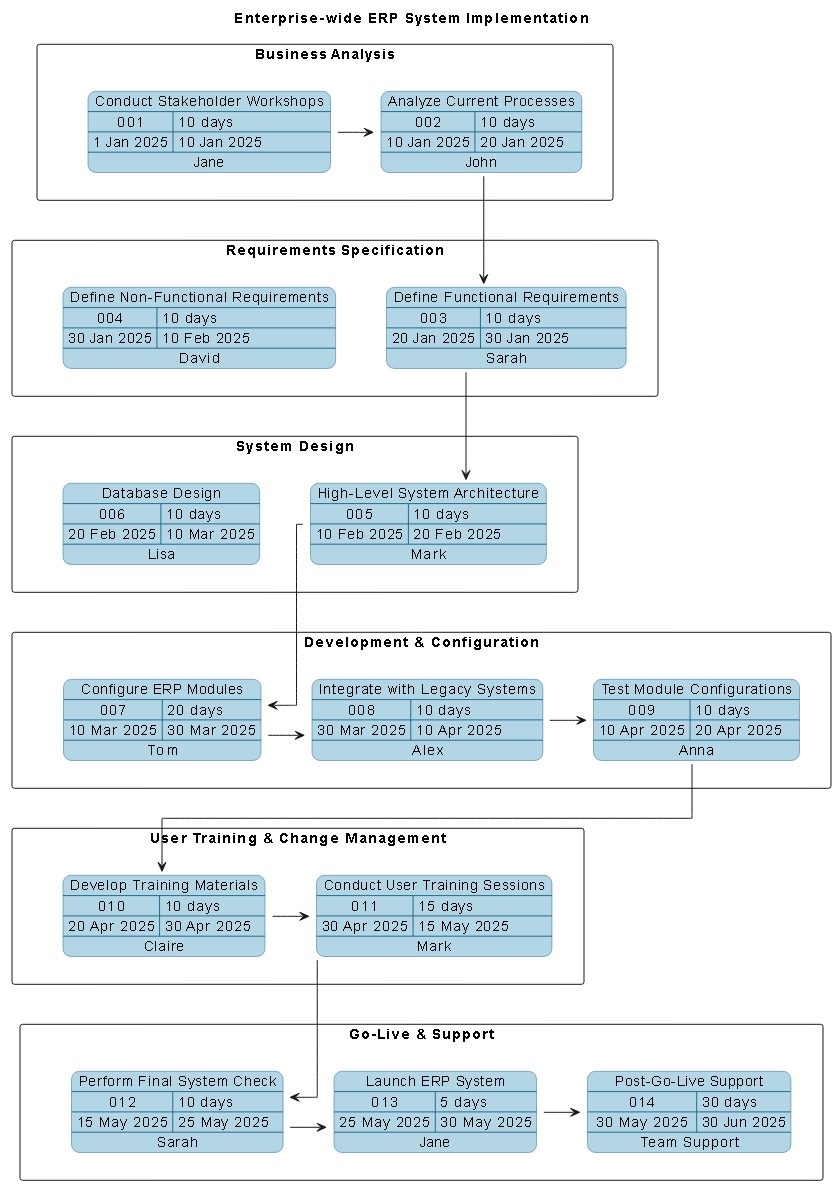
When a user requested a PERT chart for an ERP implementation, the AI didn’t just generate a static timeline. It began by interpreting the context: a multinational rollout requiring phased workstreams, cross-functional handoffs, and strict dependency tracking. The result was a dynamic, multi-lane PERT chart structured around key project phases—Business Analysis, Requirements Specification, System Design, Development & Configuration, User Training, and Go-Live & Support.
From Prompt to Precision: The Evolution of the PERT Chart
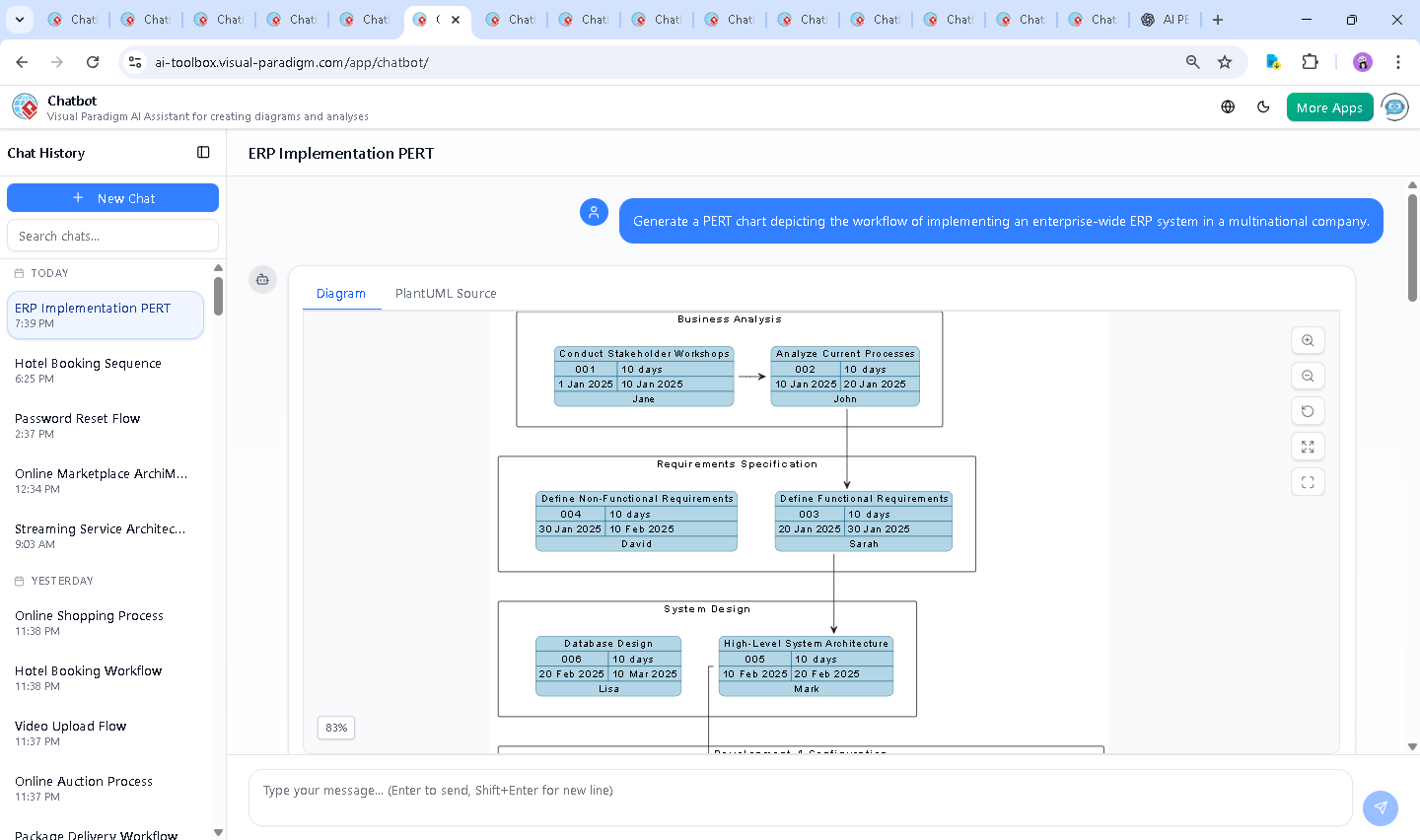
The initial request—“Generate a PERT chart depicting the workflow of implementing an enterprise-wide ERP system in a multinational company”—set the stage. The AI responded with a fully structured PlantUML script, pre-configured with realistic dates, durations, responsible roles, and critical dependencies. But the real value emerged through conversation.
When the user asked, *“How can we ensure data integrity during the integration with legacy systems?”*, the AI didn’t default to a generic answer. Instead, it delivered a structured, actionable strategy—complete with data mapping, validation rules, real-time monitoring, and a parallel run phase. This wasn’t just a response; it was expert-level project guidance.
Recognizing the need for deeper clarity, the user followed up: *“Explain this branch.”* The AI responded by breaking down the integration workflow into a step-by-step process, using a real-world example of legacy finance system migration. It highlighted how date format normalization, field-level validation, and reconciliation testing form the backbone of data integrity—directly tied to the PERT task *“Integrate with Legacy Systems”*.
This back-and-forth exemplifies the AI Chatbot’s role as a modeling consultant. It doesn’t just create diagrams—it evolves them through intelligent dialogue, refining logic, clarifying assumptions, and enriching the model with domain-specific insights.
Decoding the PERT Chart Logic: Why This Structure Works
The generated PERT chart uses a multi-lane layout to represent parallel workstreams across different project phases. Each lane groups related tasks, ensuring clarity in ownership and sequencing. The timeline spans from January 2025 to June 2025, reflecting a realistic 6-month rollout window.
Key structural choices reflect best practices in project planning:
- Sequential Dependencies: Tasks are linked with
$dependency()calls to enforce logical flow. For example,task02 (Analyze Current Processes)must complete beforetask03 (Define Functional Requirements)can begin. - Parallel Task Streams: While some tasks are strictly sequential, others run in parallel—such as
High-Level System ArchitectureandDatabase Design—allowing teams to work concurrently without bottlenecks. - Resource Accountability: Each task assigns a responsible individual, promoting ownership and traceability. For instance,
Tomleads ERP module configuration, whileAnnaoversees testing. - Buffer Time & Milestones: The chart includes a 10-day buffer between major phases, such as the 10-day gap between
Test Module ConfigurationsandDevelop Training Materials, to allow for review and adjustment.
The choice of PERT over Gantt is strategic: PERT emphasizes critical path analysis and dependency tracking—essential when managing complex, interdependent workflows across global teams. It highlights the longest path through the project, enabling early identification of risks and delays.
Conversational Intelligence in Action
What truly sets the Visual Paradigm AI Chatbot apart is its ability to act as a living design collaborator. The chat history shows a natural, iterative dialogue where the user’s questions led to deeper model enrichment:
- After the initial PERT chart was generated, the user asked for data integrity guidance—prompting the AI to provide a structured strategy.
- The follow-up request to “explain this branch” triggered a detailed breakdown of the integration workflow, linking it directly to the PERT task.
- The AI then offered to generate supplementary diagrams—such as a Sequence or Activity diagram—showing how data flows during integration, demonstrating its capacity to extend the model beyond the original request.
This level of responsiveness isn’t automation—it’s intelligent co-creation. The AI doesn’t just react; it anticipates needs, provides context, and enhances the model with domain expertise.
More Than Just PERT: A Unified Modeling Platform
The Visual Paradigm AI Chatbot isn’t limited to PERT charts. It supports a full spectrum of modeling standards, making it a complete solution for IT and enterprise architects:
- UML: For system design, component modeling, and behavioral analysis.
- ArchiMate: For enterprise architecture, aligning business, application, and technology layers.
- SysML: For systems engineering, including requirements, behavior, and parametric modeling.
- C4 Model: For software architecture visualization, from context to containers and components.
- SWOT, PEST, Org Charts, Mind Maps: For strategic planning, stakeholder analysis, and knowledge organization.
Whether you’re mapping business processes, designing cloud-native systems, or visualizing change management, the AI Chatbot adapts to your modeling language and workflow—acting as a consistent, intelligent partner across standards.
Final Thoughts: Plan Smarter, Collaborate Better
Enterprise-wide ERP implementation demands more than a timeline—it demands clarity, accountability, and foresight. The Visual Paradigm AI Chatbot transforms this challenge into a collaborative journey, where every question refines the model, every insight strengthens the plan.
By combining AI-driven intelligence with professional-grade modeling standards, Visual Paradigm doesn’t just generate diagrams—it builds shared understanding across teams, departments, and continents.
Ready to design your next enterprise project with confidence? Explore the full ERP PERT chart session and experience how the AI Chatbot turns ideas into actionable, intelligent models.