


Designing a Future-Ready Smartwatch: AI-Powered Requirement Modeling for Power, Durability, and Usability
Creating a smartwatch that excels in battery life, resilience, and user experience demands more than intuition—it requires precise, traceable, and testable requirements. Yet, translating high-level product goals into structured, standardized models often feels like navigating a maze of technical jargon and diagramming complexity.
Enter the Visual Paradigm AI Chatbot—a collaborative modeling expert that transforms abstract ideas into fully realized SysML requirement diagrams through natural conversation. Instead of wrestling with syntax or manual layout, users guide the AI with plain-language prompts, and the platform delivers professional-grade models instantly.
From Prompt to Precision: The Interactive Journey
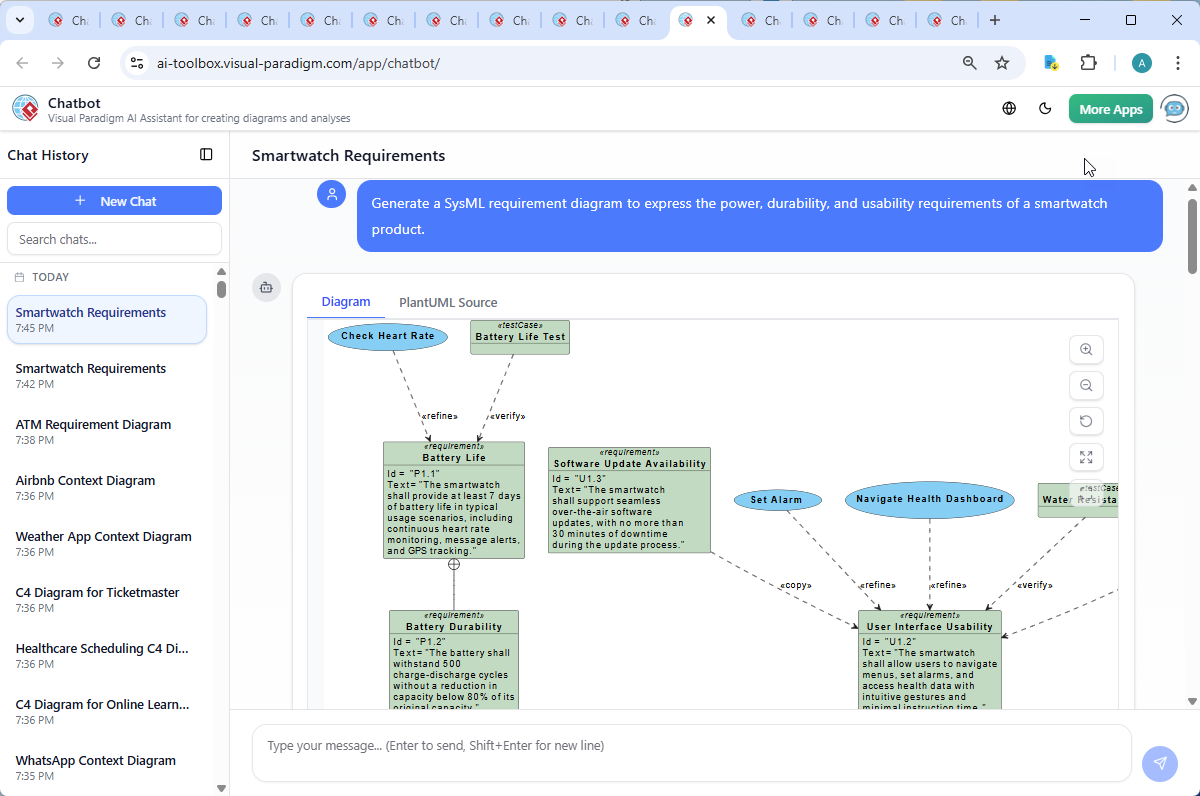
The journey began with a simple request: “Generate a SysML requirement diagram to express the power, durability, and usability requirements of a smartwatch product.” Within seconds, the AI delivered a fully structured PlantUML script embedded with SysML semantics, including requirement definitions, use cases, test cases, and traceability links.
But the real value emerged in the conversation that followed. When the user asked, “Can you explain how the battery durability requirement (req02) is tested in practice?”, the AI didn’t just offer a definition—it provided a detailed, real-world testing protocol, complete with cycle parameters, measurement benchmarks, and pass/fail criteria. This wasn’t a static output; it was a living design dialogue.
Further refinements were made on the fly: the user requested a clearer breakdown of how the req05 (water resistance) and req06 (impact resistance) were related. The AI responded with a $deriveReqt(req05, req06) annotation, illustrating how one requirement logically stems from another—enabling better design trade-off analysis.
Each follow-up—whether asking for a test case diagram or requesting clarification on traceability—was met with expert-level insight, proving that the AI Chatbot isn’t just a diagram generator. It’s a modeling consultant, capable of explaining the why behind every notation.
Decoding the Logic: Why This Diagram Works
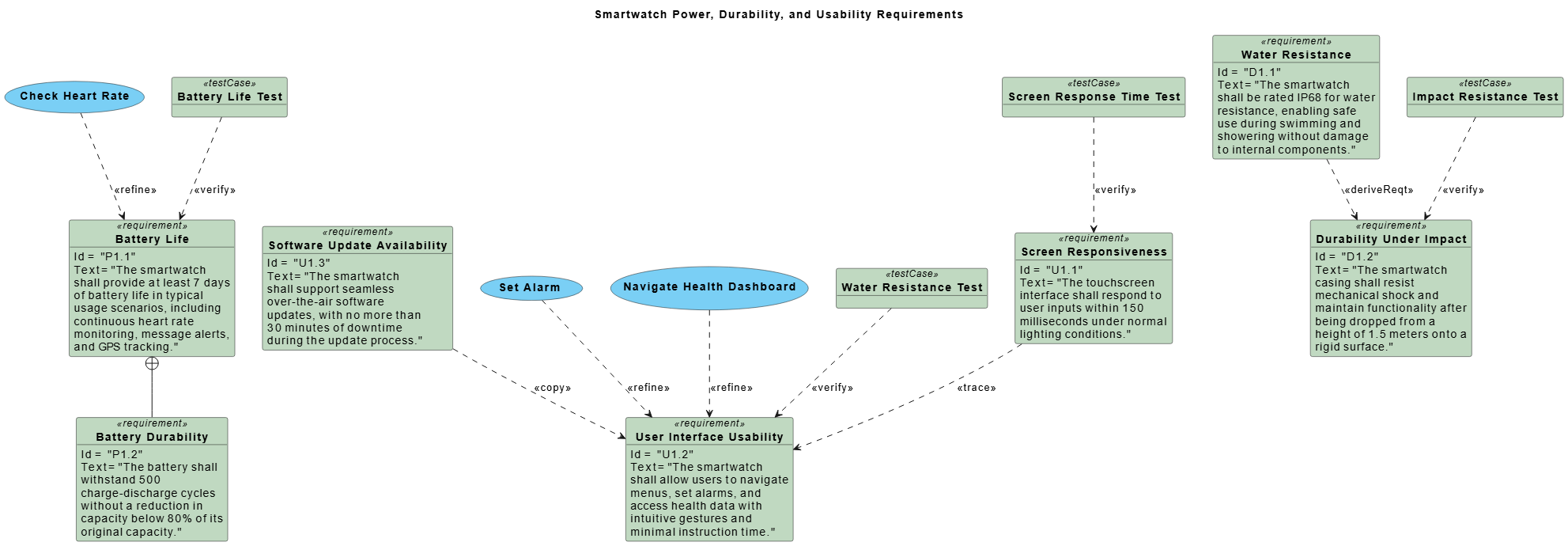
The generated SysML Requirement Diagram is not just visually clean—it’s engineered for engineering rigor. Here’s how each element contributes to a robust, auditable design:
Power Requirements
- req01 (Battery Life): Defines a minimum 7-day runtime under typical usage—critical for user retention and competitive positioning.
- req02 (Battery Durability): Ensures long-term reliability through 500 charge-discharge cycles with ≥80% capacity retention—this is a key differentiator in premium wearables.
Durability Requirements
- req05 (Water Resistance): IP68 rating enables use in swimming and showering—addressing a core user need for lifestyle integration.
- req06 (Durability Under Impact): 1.5m drop test ensures the device survives daily mishaps—critical for user confidence.
Usability Requirements
- req03 (Screen Responsiveness): 150ms response time under normal lighting ensures a seamless touch experience.
- req04 (User Interface Usability): Focuses on intuitive navigation and minimal learning curve—key for non-technical users.
- req07 (Software Update Availability): Seamless OTA updates with ≤30 minutes downtime support long-term software health.
Traceability & Validation
$verify(testCase01, req01): Links the battery life test to the requirement—ensuring every claim is testable.$refine(useCase01, req01): Shows how the heart rate check use case depends on battery life—highlighting system-level dependencies.$containment(req01, req02): Indicates that battery durability is a subset of overall battery performance—supporting hierarchical requirement management.$trace(req03, req04): Reveals that responsiveness impacts usability—connecting technical performance to user experience.
This structured approach enables cross-functional alignment between product, engineering, QA, and compliance teams—ensuring no requirement slips through the cracks.
Conversational Intelligence in Action
What sets Visual Paradigm apart is how the AI Chatbot evolves during the conversation. The initial diagram was already robust—but the follow-up questions unlocked deeper layers of insight:
- When asked about how battery durability is tested, the AI delivered a full testing protocol, including temperature conditions, cycle counts, and capacity thresholds.
- For traceability between water resistance and impact resistance, the AI used
$deriveReqtto show logical derivation—helping engineers understand whether one requirement implies the other. - When the user requested a test case diagram, the AI responded with a new PlantUML script, demonstrating the ability to pivot between diagram types on demand.
These interactions aren’t scripted. They reflect a real-time modeling partnership—where the AI acts as a co-designer, adapting to the user’s intent and depth of inquiry.
Beyond SysML: A Unified Modeling Platform
While this example focused on SysML, the Visual Paradigm AI Chatbot is not limited to one standard. It seamlessly supports:
- UML for software architecture and behavior modeling
- ArchiMate for enterprise architecture and business capability mapping
- C4 Model for software system context and component design
- Mind Maps, Org Charts, SWOT, PEST, and Charts (column, pie, line, area) for strategic planning and visual reporting
Whether you’re modeling a smartwatch’s embedded system, designing an enterprise IT roadmap, or visualizing market trends, the AI Chatbot adapts to your domain—delivering context-aware, accurate diagrams in seconds.
Conclusion: Design with Confidence, Not Guesswork
Designing a smartwatch isn’t just about features—it’s about building trust through measurable, traceable, and testable requirements. The Visual Paradigm AI Chatbot turns this vision into reality by transforming natural language into precise, professional-grade models—complete with validation pathways and design rationale.
With the ability to refine, explain, and expand on every element through conversation, this isn’t just a diagramming tool. It’s an intelligent design partner that grows with your project—from concept to certification.
Ready to build smarter? Explore the live Smartwatch Requirements session and experience how AI is redefining visual modeling.