


Designing a Seamless Guest Experience: The Smart Structure Behind FunWorld Theme Park
Creating a high-performing theme park isn’t just about thrilling rides—it’s about orchestrating every element of the guest journey through a clear, scalable organizational structure. The challenge lies in aligning operations, attractions, and guest services under a unified framework that responds dynamically to demand, safety, and experience quality. This is where the Visual Paradigm AI Chatbot becomes more than a diagram generator—it acts as a collaborative modeling consultant, turning abstract ideas into precise, actionable organizational blueprints.
From Concept to Clarity: A Collaborative Design Journey
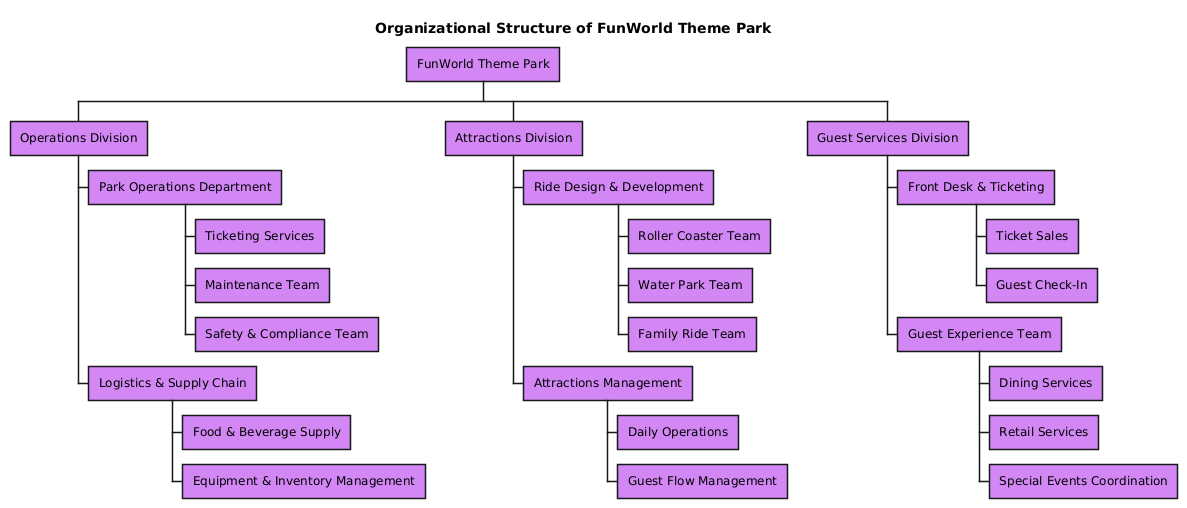
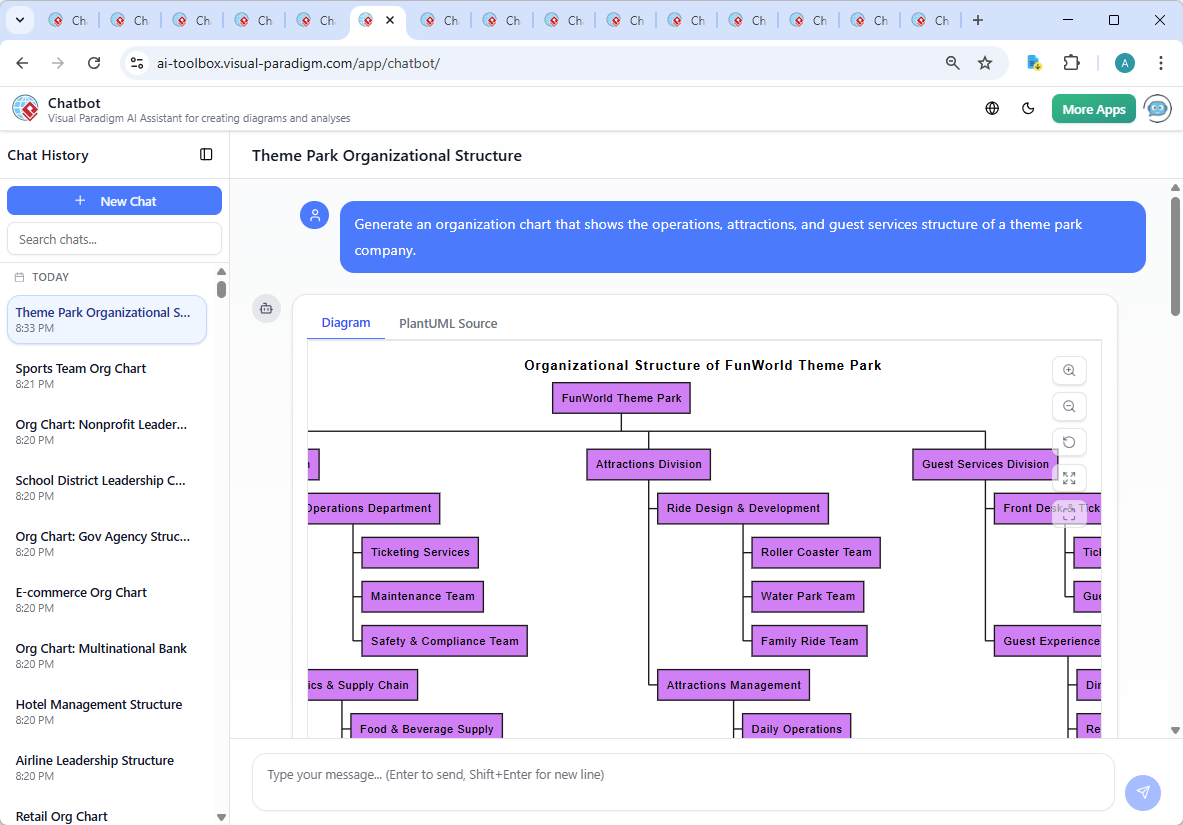
The journey began with a simple prompt: “Generate an organization chart that shows the operations, attractions, and guest services structure of a theme park company.” Within seconds, the Visual Paradigm AI Chatbot delivered a structured PlantUML WBS (Work Breakdown Structure) diagram that mapped the core divisions of FunWorld Theme Park. The initial output wasn’t just a static chart—it was a living model that invited dialogue.
As the user explored the structure, a follow-up question emerged: “How does the Attractions Management team handle guest flow during peak hours?” This wasn’t a request for a new diagram—it was a demand for deeper insight. The AI responded with a detailed, strategy-driven explanation, outlining predictive analytics, dynamic queuing, staffing adjustments, and real-time communication protocols. This wasn’t a guess—it was a synthesis of industry best practices, grounded in operational logic.
What followed was a true conversation: the user asked for a flow diagram or SWOT analysis. The AI didn’t hesitate. It offered to generate a PlantUML flow diagram or a SWOT analysis of the guest flow strategy—proof of its ability to pivot across modeling standards on demand. This isn’t automation. It’s intelligent co-creation.
Decoding the Structure: Why This Organization Chart Works
The diagram’s foundation lies in a hierarchical, divisional structure designed for scalability and operational clarity. Here’s how each layer serves a strategic purpose:
1. Core Divisions: Strategic Alignment
- Operations Division: Ensures the park runs smoothly behind the scenes. Includes Ticketing Services, Maintenance, and Safety & Compliance—critical for risk mitigation and guest trust.
- Attractions Division: The heart of the guest experience. Separates design (Ride Development) from daily execution (Attractions Management), enabling innovation without operational disruption.
- Guest Services Division: Focuses on touchpoints that define guest satisfaction—Front Desk, Dining, Retail, and Special Events. These teams are designed to be proactive, not reactive.
2. Sub-Teams: Specialization & Responsiveness
- The Roller Coaster Team and Water Park Team reflect niche expertise—essential for maintaining high safety and performance standards.
- Guest Flow Management isn’t a standalone department; it’s a function embedded in Attractions Management, ensuring real-time adaptability during peak hours.
- Special Events Coordination and Dining Services are grouped under Guest Services to maintain a unified experience, preventing silos between entertainment and food.
3. Design Logic: Why PlantUML WBS?
PlantUML’s @startwbs syntax was chosen for its clarity in hierarchical modeling. The use of nested asterisks (e.g., ** Operations Division) visually enforces the parent-child relationship, making it easy to scan and understand. The style block with a soft purple background enhances readability and aligns with FunWorld’s brand identity—subtle but intentional.
Conversational Intelligence: Where the AI Adds Value
What sets Visual Paradigm apart isn’t just the diagram—it’s the dialogue that shapes it. The AI didn’t stop at generating a chart. It anticipated the next question, offering insights into guest flow management that would take hours to research manually.
When the user asked how guest flow is managed during peak hours, the AI didn’t just list actions—it explained the why behind each strategy: predictive analytics for foresight, wave-based entry for control, and digital signage for engagement. These aren’t generic tips—they’re tailored to the structure already in place.
Even the suggestion to generate a SWOT analysis or flow diagram shows the platform’s versatility. The AI isn’t locked into one format—it understands context, intent, and the need for layered modeling.
More Than Just Charts: A Full Modeling Ecosystem
While this example focused on an Organization Chart, the Visual Paradigm AI Chatbot is built to handle a full spectrum of modeling standards—making it a true AI-powered visual modeling platform. Whether you need:
- UML for software system design
- ArchiMate for enterprise architecture
- SysML for complex system engineering
- C4 Model for software architecture visualization
- Mind Maps, PERT Charts, Org Charts, SWOT, PEST, and more
…the same AI intelligence applies. It understands the semantics of each standard and adapts its responses accordingly. This means you’re not switching tools—you’re using one intelligent assistant across your entire design lifecycle.
Conclusion: Build Smarter, Faster, Together
FunWorld Theme Park’s organizational structure isn’t just a chart—it’s a blueprint for resilience, scalability, and guest delight. With the Visual Paradigm AI Chatbot, creating such a model isn’t a solitary task. It’s a dynamic conversation between human intent and AI expertise.
Whether you’re designing a theme park, a software system, or an enterprise architecture, the platform empowers you to move from idea to visual model with confidence. The AI doesn’t just generate diagrams—it guides, refines, and anticipates.
Ready to build your next model? Explore the FunWorld Theme Park example in real time—and experience how AI transforms modeling into a collaborative art.