


Managing large-scale initiatives, product launches, or software development projects can quickly become overwhelming without clear scope boundaries. A Work Breakdown Structure (WBS) decomposes a complex project into smaller, manageable components, giving project managers and deliverables owners complete visibility into project scope.
By leveraging an AI Chatbot, you no longer need to manually draw flow charts, align sub-task boxes, or rearrange layout nodes. You can convert project scope statements, deliverables lists, or meeting notes into a fully structured WBS in seconds using simple conversational prompts.
What is a Work Breakdown Structure (WBS)?
A Work Breakdown Structure is a deliverable-oriented hierarchical decomposition of the total scope of work to be carried out by the project team. It organizes project commitments into logical sections and breaks deliverables down into detailed work packages.
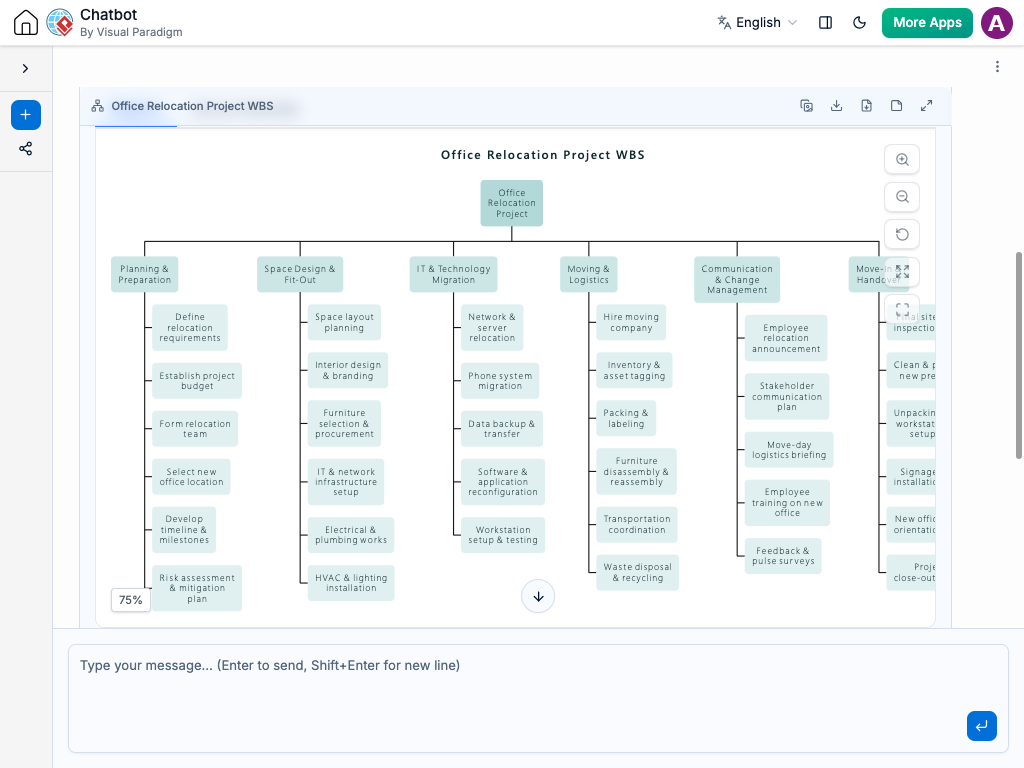
Key Components of a WBS
-
Project Root / Level 1: The overarching project objective or final deliverable (e.g., E-Commerce Website Relaunch).
-
Control Accounts / Level 2: Major project phases, functional areas, or primary deliverables (e.g., UI/UX Design, Backend Development, Marketing Launch).
-
Work Packages / Level 3+: The lowest level of deliverables where effort, cost, and responsibility can be easily estimated and managed.
-
WBS Dictionary Code: A standardized numbering scheme (e.g., 1.1, 1.1.2) used to track individual work packages across schedule management tools.
Why Use a Work Breakdown Structure?
Deconstructing your project scope visually before jumping into execution provides essential benefits:
-
Prevent Scope Creep: Sets clear boundaries on project deliverables, making it easy to spot out-of-scope feature requests.
-
Accurate Cost & Schedule Estimation: Breaking work down into granular packages makes labor hours, budgets, and timelines significantly easier to calculate.
-
Clear Accountability: Assigns specific work packages to individual owners or cross-functional teams without confusion.
-
Streamlined Project Tracking: Provides a baseline structure for building Gantt charts, sprint backlogs, and milestone schedules.
Common Real-World Use Cases
Work Breakdown Structures are utilized across project management methodologies in various industries:
-
Product Marketing Launches: Organizing campaigns across content creation, digital advertising, PR outreach, and event management.
-
Software Product Engineering: Structuring frontend UI, backend microservices, database architecture, testing, and deployment pipeline tasks.
-
Event & Conference Management: Managing venue selection, speaker management, marketing promotion, and onsite logistics.
-
Enterprise System Migrations: Planning data auditing, cloud infrastructure setup, security compliance, and user training.
How to Generate a WBS Using AI Chatbot
Creating a Work Breakdown Structure with Visual Paradigm’s AI Chatbot takes just a few simple steps:
-
Open the AI Chatbot Workspace: Launch the diagramming workspace in your browser.
-
Describe Your Project Scope: Enter your project deliverables, phase descriptions, or outline directly into the AI Chatbot window.
-
Specify the Diagram Type: Tell the AI Chatbot to generate a “Work Breakdown Structure” or “WBS.”
-
Review and Render: The AI Chatbot organizes your scope items into a clean hierarchical tree automatically.
-
Refine with Natural Language: Ask the AI Chatbot to add sub-deliverables, rename categories, or adjust levels using quick chat commands.
Practical AI Chatbot Prompt Examples
Try using these prompt statements inside the AI Chatbot to generate instant WBS diagrams:
Example 1: Product Marketing Launch
Create a Work Breakdown Structure for a product marketing launch, covering Content Creation, Digital Advertising, PR Outreach, and Event Management.
Example 2: Mobile App Development Project
Create a Work Breakdown Structure for a mobile app development project, breaking down UX/UI Design, Frontend Development, Backend API Setup, Quality Assurance, and App Store Deployment into key work packages.
Best Practices for Designing Clear WBS Diagrams
To ensure your Work Breakdown Structure is actionable and easy to follow, keep these best practices in mind:
-
Focus on Deliverables, Not Actions: Name nodes using outcome-focused nouns (e.g., User Interface Design instead of Designing the UI).
-
Apply the 100% Rule: The WBS must encompass 100% of the work defined by the project scope—no more and no less.
-
Maintain Mutually Exclusive Elements: Ensure work packages at the same level do not overlap in scope or deliverables.
-
Keep Decomposition Manageable: Avoid over-decomposing tasks into micro-steps; limit your tree depth to 3 or 4 levels where work can be realistically estimated.